Commercial Roof Maintenance
The Shield Maintenance Program — Structured, Documented, and Warranty-Preserving
Most commercial building owners in Amarillo do not have a roof maintenance program — they have a call list for when something leaks. The Shield Maintenance Program is built the other way: semi-annual inspections, written reports, and priority response after severe weather.
Why the Panhandle Requires a Formal Program — Not Ad-Hoc Calls
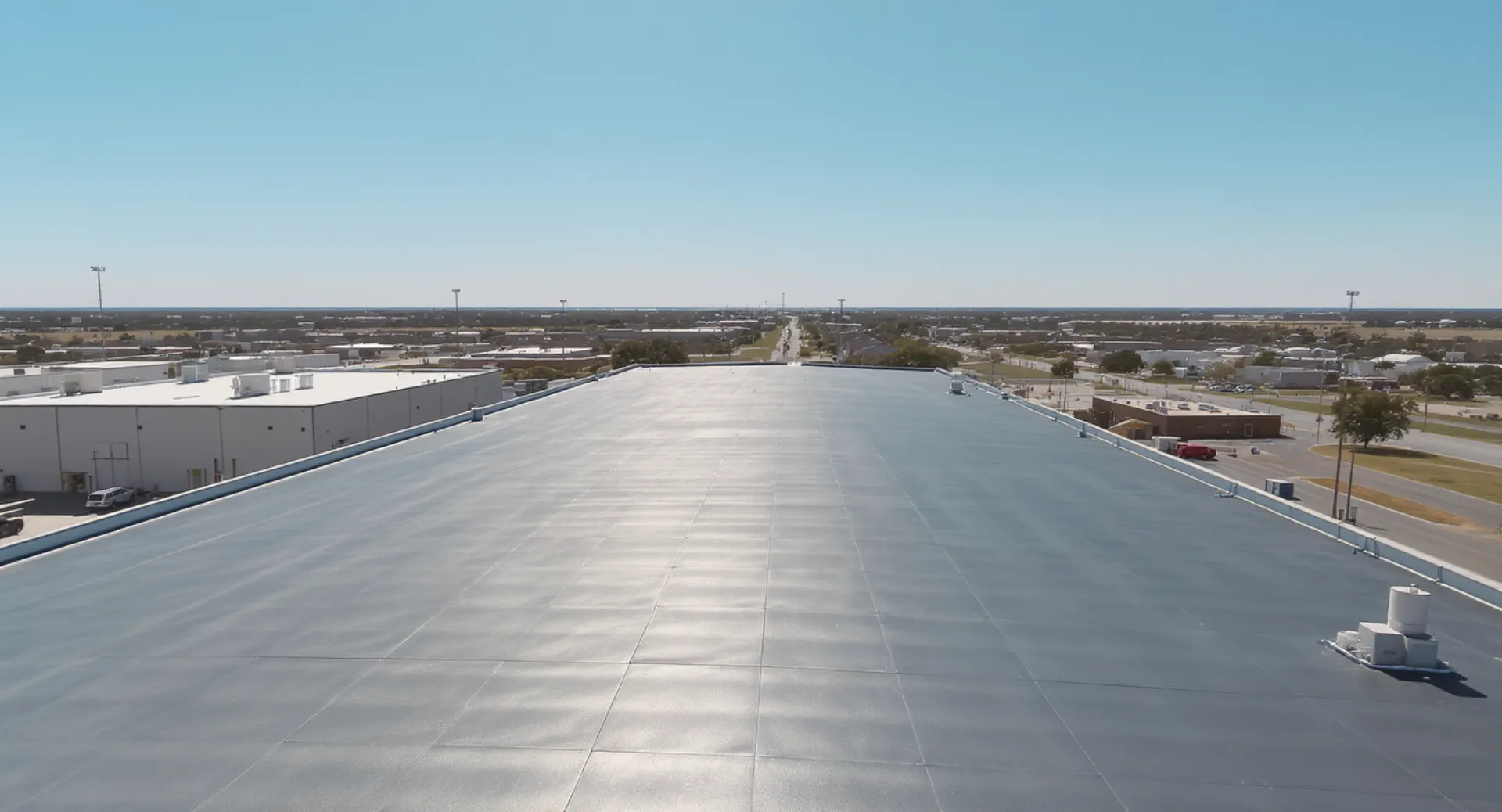
Commercial roofing maintenance is a documented discipline, not a discretionary budget line. In most building markets, a reactive approach — call when it leaks — produces mediocre outcomes at predictable cost. In the Texas Panhandle, it produces the same outcomes faster and more expensively, because the climate here does not give roofing systems a maintenance vacation.
Amarillo records approximately ten freeze-thaw cycles per year — the number of times ambient temperature crosses 32°F in both directions. Each cycle stresses seams, flashings, and any coating that relies on adhesion to a rigid substrate. Thermal cycling across a 120-degree annual temperature range — from single-digit winter lows to 110-degree summer highs — works seam edges and penetration flashings in ways that accumulate over time. At 3,607 feet elevation, UV intensity is measurably higher than any other major Texas city, accelerating polymer degradation in membrane surfaces. And then there is hail: NWS records place Amarillo squarely in Hail Alley, and the May 28, 2013 storm alone produced roughly $500 million in insured losses across the metro — events with stones large enough to dent metal, compress insulation, and create micro-punctures in membranes that admit water long before any visible surface crack appears.
The National Roofing Contractors Association recommends a minimum of two inspections per year — spring and fall — as the baseline maintenance cadence for commercial low-slope roofing. That is also the standard that most manufacturer NDL warranties require as a condition of coverage. A Mule-Hide Premium NDL warranty on a correctly installed 60-mil TPO roof is worth something: it means the manufacturer covers full repair and replacement cost with no dollar limit and no amortization. It means nothing on a building where the inspection record required to support a warranty claim does not exist.
The Shield Maintenance Program is built around this reality. It is a named, structured program — not a generic service offering — because most commercial roofing competitors in this market do not productize maintenance as a recurring, documented, SLA-bound service. Property managers and facility directors who carry roof assets on their balance sheets need budget line items and deliverable reports, not ad-hoc call responses. This program is designed for that audience.
- Inspection Cadence
- Semi-annual (NRCA minimum)
- Timing
- Spring + Fall
- Post-Storm Response
- Within 5–10 business days
- Storm Trigger
- Hail or wind ≥70 mph
- Inspection Report
- Written + dated photo log
- Findings Classification
- Active / Near-term / Monitor
- Warranty Compliance
- Mule-Hide NDL documentation
- Drain Clearing
- Included each inspection
- Repair Authorization
- Written scope before work
- NRCA-recommended minimum inspection cadence
- 2×/yr
- Annual freeze-thaw cycles (NOAA — Amarillo)
- 10
- NRCA minimum inspection cadence
- 2×/yr
- Insured losses — May 2013 Amarillo hailstorm
- 500M
What the Inspection Actually Covers
A legitimate semi-annual inspection is not a visual drive-by and a phone call. It is a systematic walk of every component in the roofing assembly — membrane, seams, penetrations, drains, edge metal, copings, parapet walls, and equipment supports — using a documented checklist, a probe tool for seam testing, and a camera.
The perimeter walk addresses edge metal, coping caps, and fascia. These are the first components to fail in Panhandle wind events — ANSI/SPRI ES-1 governs their wind resistance, but fastener pullout from repeated flexing is a cumulative process. Copings that are moving but not yet separated can be re-secured at minimal cost; copings that have separated and admitted water behind the parapet wall require significantly more work to remediate.
Penetration flashings at HVAC curbs, exhaust fans, pipes, and conduit sleeves account for a disproportionate share of commercial roof leaks. Each flashing is probed for adhesion loss and visually inspected for separation, cracking, or peel-back. HVAC units shift thermally, and curb flashings that were properly bonded at installation can work loose over multiple heating and cooling seasons. Finding and re-bonding a lifting flashing takes minutes at inspection; finding it after it has been admitting water for a full season takes hours and typically involves interior damage as well.
Drain strainers are cleared of debris — Panhandle dust accumulation and cottonwood seed can block a drain strainer in a single season — and drain bodies are inspected for integrity and proper bonding to the membrane. Standing water that remains more than 72 hours after a rain event indicates either a blocked drain or an inadequate slope condition; both are documented and classified for follow-up.
The written report delivered after each inspection includes: date and inspector identity, weather conditions at inspection, photograph documentation of every finding with GPS-referenced location on a roof plan, classification of each finding by urgency, and a recommended repair scope for any near-term items. That report goes to you within five business days of inspection and is filed in our records for warranty documentation purposes. For buildings needing active repair work, maintenance inspection findings drive the repair scope — not a contractor's assumption about what is wrong from ground level.
Why Documentation Is the Program's Core Value
The documentation record from a structured maintenance program serves three distinct purposes beyond the physical inspection itself: warranty defense, insurance claim support, and facility asset management.
Warranty defense: if a Mule-Hide NDL warranty claim is filed at year twelve, and the manufacturer investigates, the question is whether the damage was caused by a covered manufacturing defect or by lack of maintenance. A twelve-year inspection record showing biannual inspections, documented repairs, and no deferred maintenance eliminates that question. A building with no maintenance record puts the warranty holder in a difficult position regardless of what caused the failure.
Insurance claim support: the May 28, 2013 Amarillo hailstorm produced $500 million in insured losses from baseball-sized hail that damaged an estimated 75% of residential property in the city. Commercial buildings suffered equivalent exposure. Buildings with pre-storm inspection records showing the roof was in good condition could demonstrate that storm damage was new damage, not pre-existing deterioration — a distinction that determines whether a claim is paid in full, partially paid, or disputed. Texas Department of Insurance mandates 20–35% premium discounts for Class 4 impact-rated assemblies; the documentation package from Shield Maintenance inspections supports that filing with your carrier.
Facility asset management: AISD manages approximately 55 school buildings across Amarillo — that scale of roof portfolio requires a documented maintenance record to budget capital replacements rationally. School districts, hospital systems, and commercial property managers operating multiple buildings need the same thing: a current condition assessment for each building that allows prioritized capital planning. Shield Maintenance Program reports are formatted for multi-building portfolio management, not just single-building reactive response. Learn more about new system options in our commercial roofing systems guide.
Post-Storm Response Protocols
The standard NRCA semi-annual cadence is a floor, not a ceiling, in the Texas Panhandle. After any hail event, 70+ mph wind event, or ice storm, Shield Maintenance Program enrollees receive priority scheduling for a post-storm inspection within 5–10 business days. That timeline matters: insurance carriers have documentation deadlines for storm damage claims, and damage documented within days of an event is more defensible than damage documented weeks later when the contractor's schedule cleared.
Post-storm inspections specifically look for: hail denting on metal edge metal and HVAC equipment (which indicates hail size and energy level that also struck the membrane); membrane surface bruising or micro-punctures from direct hail impact; edge metal displacement from sustained wind uplift; flashing separation from wind-driven movement; and debris accumulation that is blocking drains. We photograph hail impact evidence on soft metal (AC units, gutters, downspouts) as corroborating evidence of the hailstone size for insurance documentation.
Emergency temporary repairs — tarping, emergency sealant, drain clearing — are available to Shield Maintenance Program enrollees within 24–48 hours of a major storm event pending the scheduled formal inspection. For buildings with active water intrusion, temporary protection stops the damage clock while the full scope assessment is conducted. Learn more about commercial roof repair and how inspection findings drive repair scopes, or review our replacement criteria when maintenance findings indicate the system is approaching end of life. Government facilities can review our SDVOSB contracting capabilities.
Roof Maintenance — Questions We Get Often
- The National Roofing Contractors Association recommends a minimum of two inspections per year — spring and fall — for commercial low-slope roofing. Spring inspections address damage from the winter freeze-thaw season; fall inspections prepare the roof for winter loading before temperatures drop. Most Mule-Hide NDL warranties require documented semi-annual inspections to remain valid. In Amarillo specifically, a third inspection protocol matters: post-severe-weather response within 5–10 business days of any hail event, 70+ mph wind event, or ice storm. In a metro where a single hailstorm — May 28, 2013 — produced roughly $500 million in insured losses, post-storm protocols are not optional.
- Each semi-annual inspection covers: full perimeter walk of edge metal, copings, and fascia for loosening or separation; probe inspection of all field seams for lifting or fishmouths; visual and probe assessment of all penetration flashings at HVAC curbs, pipes, and conduits; drain strainer cleaning and drain body condition check; membrane field documentation for blistering, cracking, punctures, and discoloration; parapet wall and counterflashing inspection; and a written report with dated photographs keyed to roof area. All findings are classified by urgency: active leak, near-term repair needed, or monitor. Priority storm response is included — when a severe weather event hits the Panhandle, enrolled buildings move to the front of the inspection queue.
- Yes — most Mule-Hide NDL Premium warranties explicitly require documented semi-annual inspections as a condition of warranty validity. Missing those inspections does not automatically void the warranty, but if a claim is filed and the inspection record shows gaps, the manufacturer's response will be to investigate whether the damage was caused by a covered defect or by lack of maintenance. A documented inspection record eliminates that ambiguity entirely. We provide inspection reports in a format that satisfies Mule-Hide warranty documentation requirements, and we file copies on your behalf.
- In order of frequency: penetration flashing separation (HVAC curbs shift with thermal expansion; flashings that are not re-secured annually can open gaps that admit water); seam lifting at membrane laps (thermal cycling — Amarillo's 120-degree annual temperature swing — stresses seam edges, particularly on older mechanically attached systems); drain blockage (Panhandle dust, cottonwood seed, and windblown debris accumulate faster than in most Texas cities); edge metal loosening (repeated high-wind events work fasteners over time); and UV surface chalking on TPO membranes older than 15 years (indicates the membrane surface is approaching end of useful reflective life — addressable with coatings before full replacement is needed).
- All findings are classified at inspection into three categories: active leak (repair within 24–48 hours, weather permitting), near-term repair needed (schedule within 30 days), and monitor (document at next inspection). For Shield Maintenance Program enrollees, minor repairs — seam re-welding, drain flashing patches, fastener re-seating — are addressed at a fixed program rate. Major repairs are quoted separately with a written scope. You always receive the full inspection report before any repair work is authorized, so you can make an informed decision on timing and scope.
- Yes. We inspect and maintain commercial roofs regardless of who installed them. The enrollment process begins with a baseline inspection that documents existing conditions — membrane system, age, known damage, and warranty status. That baseline becomes the starting record from which all future inspection findings are compared. For roofs installed by other contractors with manufacturer warranties still in force, we review the warranty documentation and ensure our maintenance scope satisfies whatever the manufacturer requires.
- The data consistently shows yes. A minor seam lift caught at a semi-annual inspection and re-welded costs a fraction of the repair needed after that same seam has been admitting water into insulation for six months. Wet insulation in a commercial assembly can double in cost to remediate for every year it remains wet — it compresses, loses R-value, and creates a substrate that adhesives and new membranes cannot bond to properly. The May 2013 Amarillo hailstorm caused $500 million in insured losses across the metro — buildings with documented pre-storm roof conditions had faster, less-disputed insurance claims than buildings with no maintenance record. Documentation pays.
- Commercial roof insurance claims require documentation that the damage occurred in the event being claimed — not from pre-existing deferred maintenance. An inspection record that shows the roof was in good condition at the prior semi-annual inspection, followed by a post-storm inspection report identifying new hail or wind damage, is exactly what commercial insurance adjusters need to process a claim without a prolonged investigation. Without that before-and-after documentation chain, adjusters routinely attribute damage to wear and defer or deny claims. Shield Maintenance Program inspection reports are formatted to satisfy commercial carrier documentation requirements.
How often does a commercial roof in Amarillo need to be inspected?
What does the Shield Maintenance Program include?
Does a maintenance program actually preserve my manufacturer warranty?
What are the most common maintenance findings on Amarillo commercial roofs?
What happens when the inspection finds damage that needs repair?
Can I enroll a roof that was not installed by Centennial Shield?
Is roof maintenance cost-effective compared to reactive repair?
How does post-storm inspection documentation help with insurance claims?
Shield Maintenance Program
Enroll your building before the next hail season.
Semi-annual inspections, written reports, warranty documentation, and priority storm response — delivered as a structured program, not ad-hoc calls.
SDVOSB set-aside eligible — Government contracting capabilities →