
Industrial Roofing
Industrial Facilities Demand More Than a Commercial Roofer
Refineries, chemical plants, and food processing facilities in the Texas Panhandle present roofing challenges that standard commercial contractors are not equipped to handle — chemical exposure, safety compliance, operational scheduling, and contractor pre-qualification requirements that most crews have never navigated.
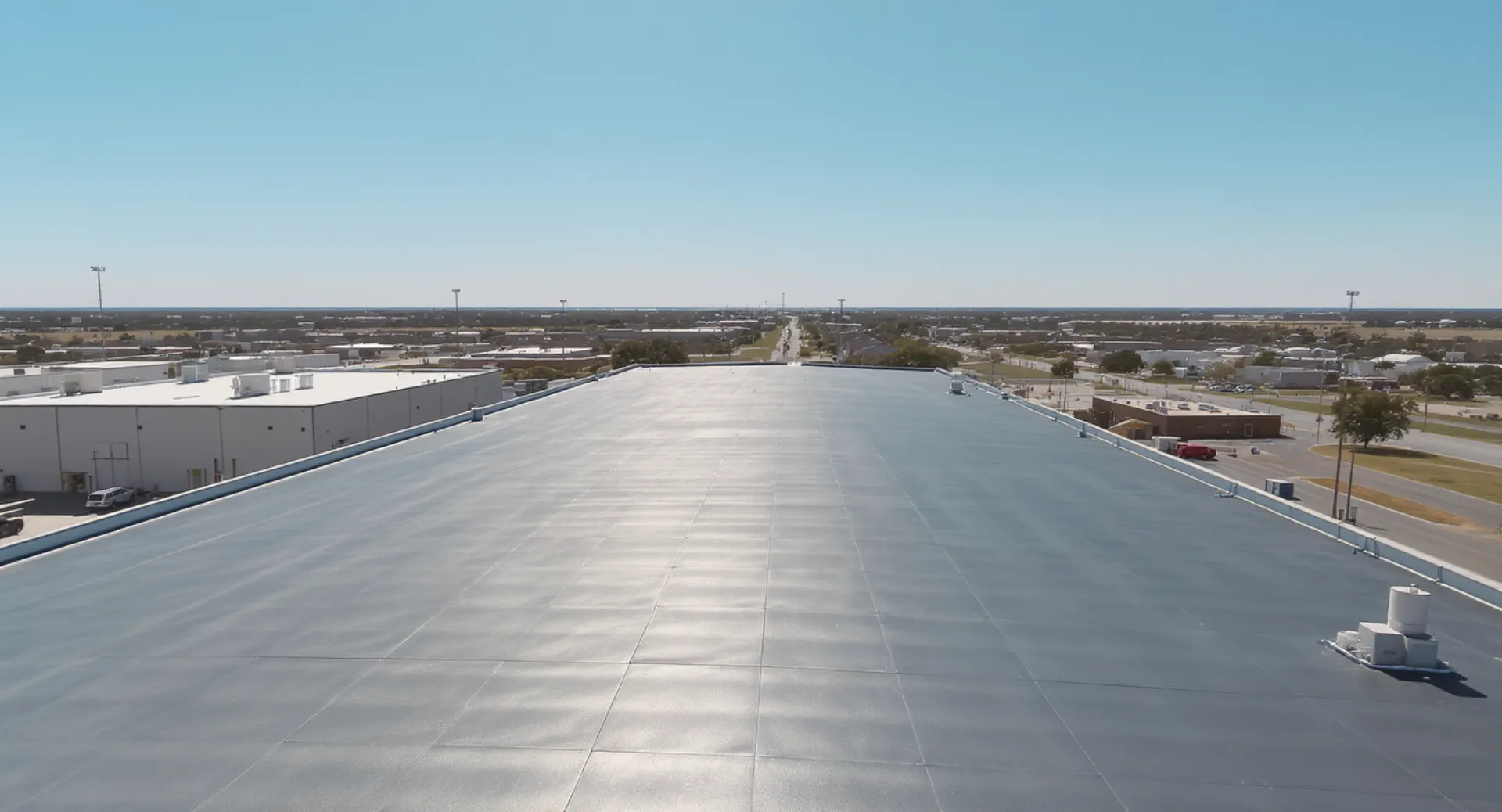
The Industrial Roofing Difference
The Texas Panhandle hosts one of the most concentrated industrial corridors in the South-Central United States. Borger's petrochemical complex — anchored by the Phillips 66 refinery at approximately 146,000 to 150,000 barrels per day of crude throughput and the adjacent Chevron Phillips Chemical operations producing more than 60 distinct chemical compounds — represents the kind of industrial density that demands roofing contractors with specific qualifications, not just general commercial experience. Fifty miles north on US-287, the Valero McKee refinery in Sunray processes up to 200,000 barrels per day and has operated continuously since 1933.
Facilities like these demand roofing systems that are correctly specified for chemical environments, installed by crews that meet the facility's safety pre-qualification standards, scheduled to align with plant operational windows, and documented to FM Global insurance standards. A contractor who shows up with a standard commercial TPO spec and no ISNetworld registration will not get past the gate — literally.
Chemical exposure is the first specification driver. Rooftop membranes on buildings near petrochemical process units are exposed to hydrocarbon vapors, sulfur compounds, ozone, solvent emissions, and in some facilities ammonia from refrigeration systems (nitrogen fertilizer facilities, food processing operations). Standard TPO can experience surface degradation under sustained exposure to these compounds. PVC membranes are the industry standard for chemical-exposure industrial environments because PVC's resistance to oils, greases, ozone, and solvent vapors is materially superior. We specify based on the specific compounds present and their proximity to the roof surface.
Safety compliance is the second driver. Every Panhandle refinery and chemical plant operates under a safety management system that governs how contractors access and work on the facility. Hot work permits, Job Safety Analysis documentation, H2S awareness training, personal gas monitors, and facility-specific orientations are not optional compliance theater — they are the mechanism by which the facility manages its liability exposure and protects its workforce. Contractors who cannot document current compliance in those systems cannot receive work orders, regardless of competitive pricing.
- Primary Membrane
- PVC (chemical zones)
- Chemical Resistance
- Hydrocarbons, sulfur, ozone
- FM Uplift Field
- FM 1-90 minimum
- FM Uplift Perimeter
- FM 1-120
- FM Hail Rating
- FM SH or VSH
- Contractor Pre-Qual
- ISNetworld / DISA / Avetta
- Safety Docs Required
- TRIR, DART, H2S training
- Turnaround Windows
- Spring (Feb–May), Fall (Sep–Nov)
- Procurement Lead Time
- 12–18 months for turnarounds
- Phillips 66 Borger refinery throughput capacity
- 146K bpd
- Valero McKee refinery capacity (Sunray, TX)
- 200K bpd
- JBS Cactus plant employees (Moore County)
- 3600+
- FM perimeter uplift target — industrial Exposure C
- 120 psf
Petrochemical and Refinery Facility Requirements
Refineries schedule planned maintenance outages — turnarounds — in spring and fall windows when process units are taken offline. These are the periods when capital roofing work on process-adjacent buildings can be executed without the operational constraints that apply during normal production. Turnaround roofing scope is typically identified and contracted 12 to 18 months before the scheduled outage. Industrial contractors who are not already in a facility's approved vendor database when scope identification begins do not participate in turnaround contracting cycles.
Building environments within a petrochemical complex vary significantly. Process-unit buildings directly adjacent to distillation columns, reactor vessels, or sulfur recovery units require PVC membranes specifically because of the vapor environment. Administrative buildings, warehouses, and maintenance shops within the same fence line but not in process areas can be specified with TPO or EPDM, which reduces system cost while maintaining the FM-rated assembly required by FM Global insurance. Specifying the right system for each building type within a complex — not defaulting to the most expensive chemical-resistant option for every structure — is one way a knowledgeable contractor delivers value on multi-building industrial campuses.
Carbon black manufacturing facilities — operations like those producing rubber-grade and specialty carbon blacks in the Borger industrial complex — create a distinct maintenance challenge. Carbon black particulate accumulates on rooftop surfaces and in drain strainers at rates that standard commercial buildings never experience. Clogged drains create ponding that accelerates membrane aging and creates warranty compliance issues. Industrial maintenance programs for these facilities need elevated inspection frequency and drain-clearing protocols to address the particulate environment.
Nitrogen fertilizer and ammonia-related facilities present a different chemical compatibility concern: ammonia is corrosive to certain metal fasteners and can interact with some adhesive formulations. Building envelopes near ammonia refrigeration or urea production operations require specification review against the specific chemical environment, not an assumption that any industrial membrane will perform acceptably. We review chemical environments in the pre-project specification phase and document membrane selection rationale.
Food Processing and Regulated Facilities
Food processing facilities represent a different class of industrial roofing complexity. Large-scale meat processing and dairy operations in Moore County — including facilities on the scale of the JBS Cactus operation with its 125-acre plant footprint and a $150 million expansion currently underway — present roofing requirements driven by USDA compliance, not just building code.
USDA Sanitation Performance Standards require food processing establishments to prevent conditions that allow product adulteration. A roof leak over a production line is a direct compliance failure — it can trigger a FSIS (Food Safety and Inspection Service) corrective action notice and, in severe cases, halt production until the condition is corrected. The financial exposure from a production stoppage at a facility processing tens of thousands of animals per day dwarfs any roofing project budget.
Proper roofing specification for food processing buildings requires: non-porous membranes (TPO or PVC) that resist microbial growth, vapor retarder placement that prevents condensation formation at the membrane-insulation interface above production rooms, insulation systems that maintain high R-values to prevent thermal bridging that creates cold surfaces where condensate forms, and penetration flashings at ammonia refrigeration penthouses that are compatible with the chemical environment without creating leakage points. High-humidity washdown environments also stress penetration details that perform adequately in dry commercial buildings.
Installation in an active production facility requires coordination with plant management on work windows, dust and debris containment to prevent foreign material entering production areas, and awareness of FSIS inspection schedules that govern when maintenance work can occur in certain production zones. Our project planning for food processing facilities addresses each of these constraints before the first crew member is on site. Government and SDVOSB contracting at federally inspected facilities is covered on our government contracting page.
Large-Footprint Project Execution
Industrial buildings in the Panhandle routinely exceed 100,000 square feet of roof surface. At that scale, execution discipline matters as much as technical specification. Material logistics — sequencing deliveries so insulation and membrane arrive when installation is ready for them, not sitting exposed on a rooftop during a forecast hail event — is a project management function. Crew scheduling to maintain production rates during weather windows, with the flexibility to staff up when forecasts open extended favorable periods, is the difference between a project that finishes on schedule and one that drags past budget.
Phased installation on occupied or partially operational facilities requires section isolation — completing and waterproofing one section before opening the next, so operations below never experience an exposed deck condition. On industrial buildings where shutting down operations below the roofing work is not feasible, we sequence installation to work outward from the highest-risk areas (drains, penetrations) first, ensuring water management is maintained throughout the project even if weather interrupts the schedule.
Wind uplift is a persistent concern on large industrial buildings. Open-plan manufacturing facilities with low parapet walls, minimal internal partitions, and large unobstructed interior volumes generate lower interior pressure than buildings with standard commercial fenestration — which means roof-to-wall differential pressure in a wind event can be higher than the simplified code calculation assumes. We consult with the structural engineer of record on large industrial projects to confirm that the specified FM uplift assembly matches the actual pressure envelope for the building geometry.
After installation, industrial buildings benefit from the same documented maintenance cadence as commercial properties — with the added urgency of chemical environment monitoring and the operational cost of any active leak. Our Shield Maintenance Program is available for industrial facilities with inspection protocols adapted to the specific chemical environment and access requirements of the facility. For system selection detail, see our pages on PVC roofing, TPO roofing, and commercial metal roofing.
Industrial Roofing — Questions From Facility Managers
- Three primary differences: chemical exposure, access and safety requirements, and operational scheduling constraints. Rooftop membranes near petrochemical process units — like those at Borger's Phillips 66 refinery or Valero McKee in Sunray — are exposed to hydrocarbon vapors, sulfur compounds, solvent emissions, and process heat that degrade standard TPO membranes. PVC is the standard industrial specification in chemical-exposure environments because its chemical resistance is materially superior. Safety requirements at refineries and chemical plants include host facility safety management systems, hot work permits, H2S awareness training, and personal gas monitors — requirements that most commercial roofing contractors are not equipped to meet. And industrial operations cannot stop for roofing work; installation must be phased around process unit schedules and planned outages.
- We maintain the contractor qualifications required to work inside industrial facility fence lines, including ISNetworld (ISN) registration for facilities that use that platform for contractor pre-qualification. ISN registration requires verified safety records including Total Recordable Incident Rate (TRIR), Days Away Restricted and Transferred (DART) rate, insurance certificates, and safety training documentation. Petrochemical facilities like Phillips 66 Borger and CPChem require these records to be current in their approved contractor database before a contractor can receive a work order. We also carry the OSHA training documentation — including H2S awareness and confined-space awareness where applicable — required for general area access on most Panhandle industrial campuses.
- PVC is the standard single-ply membrane for buildings adjacent to or within petrochemical process areas. PVC's resistance to oils, greases, ozone, and solvent vapors is materially superior to TPO in those environments — TPO can experience surface degradation under sustained exposure to hydrocarbon vapors and certain chemical compounds. For buildings in lower chemical-exposure zones on the same campus, EPDM fully adhered over HD cover board is also viable. We specify based on the building's proximity to process units, the specific compounds present, and the FM Global insurance requirements for the facility. All membrane selections are documented in the project specification before installation.
- Refineries schedule planned maintenance outages called turnarounds — typically in spring (late February through May) and fall (September through November) — when process units are taken offline for inspection and capital repairs. These are the primary windows when roofing work on process-adjacent buildings can occur, because they are the periods when the air quality, personnel access, and equipment constraints are most favorable. Turnaround contractors are typically pre-qualified and contracted 12–18 months before execution. Showing up the week of a turnaround expecting to be added to an approved contractor list is not how industrial roofing works. Engagement with the facility's procurement team needs to happen well in advance.
- Food processing facilities like large beef processing operations in Moore County present roofing challenges around condensation control, mold resistance, and sanitation compliance. USDA regulations require establishments to control condensation that could adulterate product — an aging roof with inadequate insulation creates interior drip points over production lines that are a direct food safety violation. Roofing systems for these facilities must use non-porous membranes that resist microbial growth, be installed with vapor retarder placement that prevents condensation at the membrane-insulation interface, and be executed without introducing foreign material into production areas. Installation requires coordination with plant management and, in federally inspected facilities, awareness of the federal inspection schedules that govern when work can proceed.
- Many large industrial facilities in the Panhandle carry FM Global commercial property insurance, which imposes specific requirements on roofing assemblies beyond the IBC baseline. FM Global uses FM 4470 as the test standard for low-slope assemblies — the same standard that produces FM 1-90, FM 1-120 wind uplift ratings and FM SH, FM VSH hail ratings. FM Global insured facilities typically require FM-rated assemblies, and the specific required ratings are documented in the facility's FM loss prevention report. We review FM requirements as part of every industrial project specification and provide FM assembly documentation at project completion.
- Yes. Large-footprint industrial buildings — refineries, food processing facilities, grain elevators, distribution centers — require project management, material logistics, and crew capacity that differ from standard commercial roofing. Material staging, phased installation sequencing around operational constraints, and coordination with other maintenance contractors working in the same facility simultaneously are execution factors we address in project planning before mobilization. We provide day-by-day production schedules at contract execution, updated weekly during the project.
- Standard industrial facility entry documentation includes: current general liability insurance certificate naming the facility owner as additional insured, workers' compensation certificate, current TRIR and DART safety metrics within the facility's specified threshold, ISNetworld (or similar platform) registration with current records, H2S awareness training certification for all personnel, site-specific orientation completion, and in some cases a facility-specific contractor safety agreement. Some facilities also require drug testing records and background check documentation for all on-site personnel. We maintain current versions of all these documents and can provide them on standard contractor information request timelines.
What makes industrial roofing different from standard commercial roofing?
Do you work inside refinery fence lines in Borger and the Panhandle?
What roofing membrane is correct for a petrochemical or chemical processing facility?
What is refinery turnaround scheduling, and why does it matter for industrial roofing?
How does food processing facility roofing differ from standard industrial work?
What FM Global requirements apply to large industrial roofing projects?
Can you handle large-footprint industrial roofing projects — 100,000 square feet or more?
What documentation is required to work at a refinery or chemical plant?
Industrial Roofing
Get a contractor who can get past the gate.
ISNetworld registered, PVC-certified, and familiar with turnaround scheduling — ready for refinery, chemical, and food processing facilities across the Panhandle.
SDVOSB set-aside eligible — Government contracting capabilities →