
SERVICE AREA · HUTCHINSON COUNTY
Roofing contractor in Borger, TX
Centennial Shield serves Borger's petrochemical complex, institutional facilities, and commercial properties — with the ISN credentials, membrane expertise, and SDVOSB certification that Hutchinson County's industrial market requires.
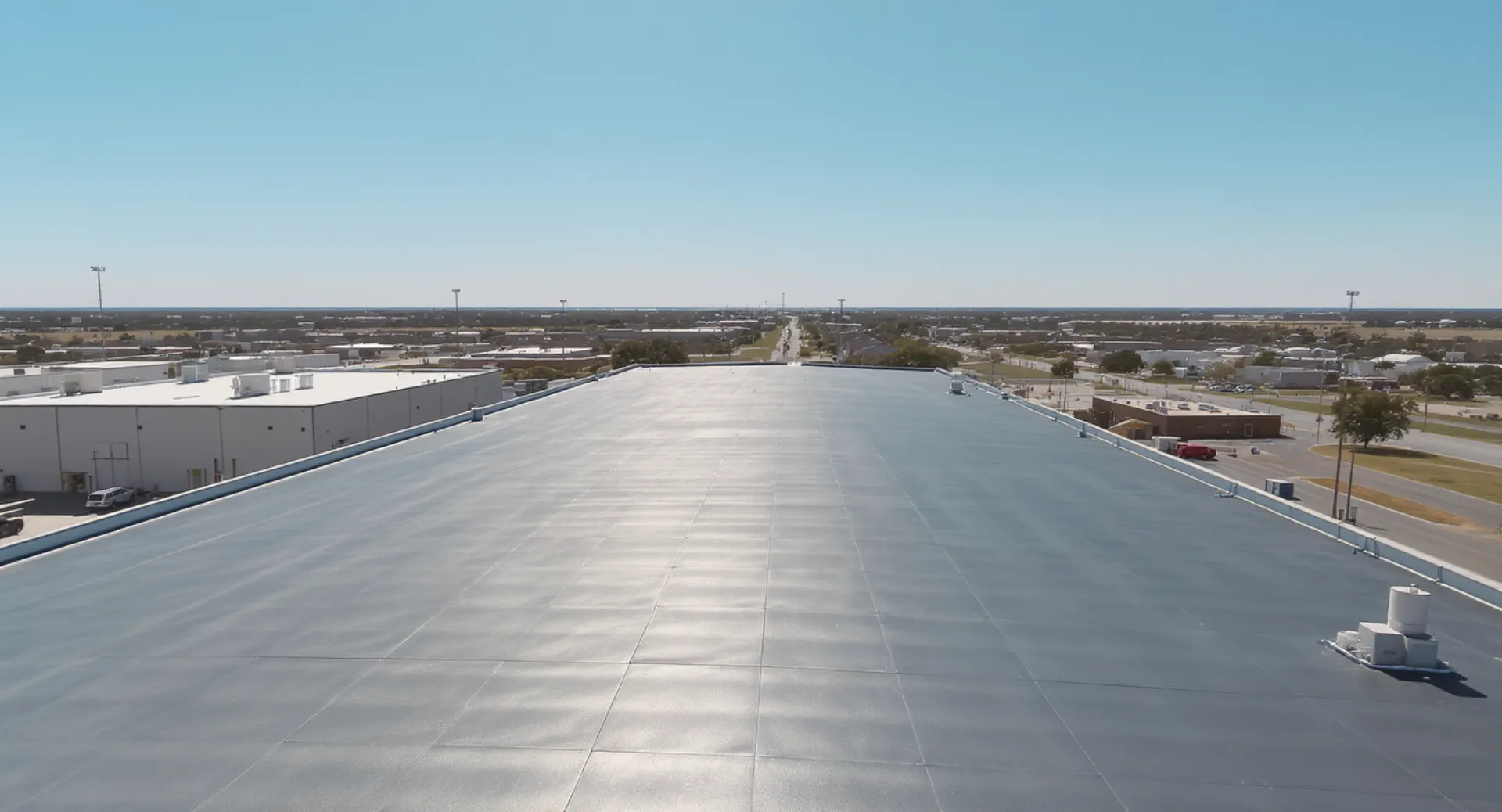
- Barrels/day — Phillips 66 Borger refinery capacity
- 146K
- From Amarillo — Centennial Shield base
- 50 mi
- NPS units in Borger market area (federal set-aside eligible)
- 2
01 / Market Context
One of the largest inland petrochemical complexes in the country. Every building on that campus has a roof.
Borger sits roughly 45 miles northeast of Amarillo at the center of an industrial concentration that would look out of place on the High Plains if it hadn't been there since the 1920s. The city's economy is built around a petrochemical campus that processes crude, manufactures specialty chemicals, produces engineering plastics, and outputs carbon black — multiple distinct operations on an integrated site that collectively employs the largest industrial workforce in Hutchinson County.
For a commercial roofing contractor, this creates a specific set of requirements: chemical-exposure membrane selection, contractor pre-qualification through third-party safety platforms, turnaround-cycle scheduling awareness, and the ability to execute work inside an industrial fence line under a host facility's safety management system. Most commercial roofers are not structured for that work. We are.
Outside the industrial complex, Borger's institutional and commercial base — Frank Phillips College, Golden Plains Community Hospital, Borger ISD, Hutchinson County government facilities, and the city's retail and service corridor — represents conventional commercial roofing work that benefits from the same crew discipline and specification rigor we bring to the industrial side.
02 / Facility Anchors
The facilities that define Borger's roofing market.
Phillips 66 Borger Refinery processes roughly 146,000 to 150,000 barrels of crude per day — primarily sour crude from West Texas and Canadian sources — producing transportation fuels, aviation gasoline, and specialty solvents. Phillips 66 moved to consolidate full ownership of the Borger facility in 2025. A refinery of this scale runs continuous facility maintenance, and roofing work tied to its planned turnaround cycles represents one of the largest commercial roofing opportunities in the Panhandle for any contractor who can meet the pre-qualification bar.
Chevron Phillips Chemical Company manufactures more than 60 distinct chemical compounds at the Borger complex — organosulfur chemicals, high-purity hydrocarbons, performance fuels, and mining chemicals. The rooftops over these production units sit in a chemically active vapor environment that eliminates most standard membrane specifications from consideration.
Solvay operates a polyphenylene sulfide production plant in Borger, a high-performance engineering plastics process that acquired ISCC PLUS mass balance certification. The strict environmental and chemical handling standards at this facility extend to contractor qualification.
Orion Engineered Carbons produces rubber-grade and specialty carbon black at its Borger plant. Carbon black manufacturing generates rooftop environments with heavy particulate loading — carbon dust clogs drains, accelerates membrane surface degradation, and creates unique drainage design requirements.
Frank Phillips College operates a multi-building campus at 1301 W. Roosevelt that includes gymnasium, instructional, and workforce training facilities — all standard low-slope commercial roofing footprints that require the same documented inspection and specification process as any institutional portfolio.
Golden Plains Community Hospital at 100 Medical Drive provides 24-hour emergency, ICU, surgical, and outpatient services. Healthcare facilities require watertight, code-compliant roofing with disruption protocols that protect patient care operations during any active roofing work.
Hutchinson County government facilities — the county courthouse, jail, and administrative buildings — are public-sector procurement opportunities where SDVOSB certification provides competitive positioning under state and federal set-aside frameworks.
03 / Industrial Specification
Chemical vapor exposure changes every membrane decision.
Rooftops within or adjacent to the Borger petrochemical campus are exposed to hydrocarbon vapors, sulfur compounds, solvent vapors from CPChem and Solvay processes, ammonia from fertilizer manufacturing operations in the area, and carbon black particulate from Orion and related carbon black producers. Standard TPO membrane — the default choice for most commercial flat roofs — degrades under sustained chemical vapor exposure at the seams and field membrane. It is the wrong specification for this environment.
PVC single-ply membrane is the correct specification for industrial rooftops near process areas. It offers superior resistance to oils, greases, ozone, and a wide range of industrial solvents, while its heat-welded seams maintain integrity under chemical exposure conditions that cause adhesive-bonded or tape-seamed assemblies to fail. We specify PVC on process-adjacent rooftops and transition to TPO or EPDM only where chemical exposure is substantially reduced by distance or building orientation.
The contractor vetting culture in Borger's refinery and chemical complex is not optional. Phillips 66 and CPChem require contractors to be pre-qualified through ISNetworld before being permitted on site — with verified safety records, incident rate documentation, and active insurance certificates on file. We maintain ISN registration for exactly this reason. A roofing contractor that has not completed that process cannot bid on industrial scope in Borger, regardless of price.
Turnaround season scheduling is a planning reality for any contractor pursuing Phillips 66 or CPChem roofing scope. Turnarounds happen twice a year — spring and fall windows — and contractor slots for work inside the facility are allocated 12 to 18 months before execution. Getting into the approved contractor database before the next turnaround cycle begins is the only way to capture that work. We treat this as procurement lead work, not reactive bidding.
- Preferred Membrane — Process Zone
- PVC (chemical-resistant)
- Contractor Pre-Qual Platform
- ISNetworld (ISN)
- Turnaround Procurement Lead
- 12–18 months typical
- Hot-Work Requirements
- JSA + facility permit
- Carbon Particulate Environments
- Drain design + inspection protocol
- Mule-Hide Certified Systems
- TPO · EPDM · PVC
04 / Climate & Permitting
Hail belt climate. Permit-required city.
Borger shares the Texas Panhandle's severe weather profile — a combination of frequent hail events, sustained high-plains wind gusts that regularly exceed design thresholds, and the thermal stress of wide temperature swings from summer heat to winter freeze cycles. Commercial membrane roofs, metal panels, and rooftop HVAC equipment in this climate take a different kind of punishment than the same systems in the Gulf Coast or DFW markets.
Hail damage on flat commercial roofs is rarely visible from the ground. Impact fatigue appears around fastener patterns, at membrane laps, and on HVAC equipment that then allows water intrusion into the roof assembly weeks or months after the storm. We conduct post-storm assessments with documentation designed to satisfy commercial insurance carrier requirements — photo grids, core samples where warranted, and written condition reports that give your insurance adjuster what they need to process a claim without a second inspection trip.
The City of Borger Planning and Development Department, located at 600 N Main Street, requires permits for commercial construction and remodeling including roof replacement. The city uses the MyGov platform for permit applications. Older industrial and institutional buildings in Borger also trigger Texas's mandatory asbestos survey requirement before any commercial re-roofing that involves tear-off — a step that catches many facility managers off guard when they are planning a project. We coordinate that process as part of pre-construction.
05 / Government & Public Sector
Federal buildings. County facilities. SDVOSB procurement.
Two National Park Service units sit within the Borger market area: Lake Meredith National Recreation Area, with headquarters in nearby Fritch, and Alibates Flint Quarries National Monument — a visitor center and NPS-managed administrative complex. Both are federally maintained buildings whose roofing and facility maintenance contracts move through federal procurement channels, including SDVOSB set-aside solicitations under FAR Part 19.
Our SBA VetCert SDVOSB certification creates procurement access that civilian roofing contractors cannot match on set-aside solicitations. When a contracting officer at an NPS unit is looking for a certified SDVOSB roofing contractor within the service area, a firm based in Amarillo — under an hour from Borger — with active SAM.gov registration is a credible answer. That positioning doesn't require us to have previously worked on a federal building; it requires current certification and the ability to execute compliant federal construction work.
At the county and municipal level, Hutchinson County government facilities and City of Borger buildings are public-sector procurement opportunities where SDVOSB status is a competitive factor on state-funded projects and where the documentation requirements — bonding, insurance, permits — are handled as standard process. Learn more about our government contracting capabilities at our SDVOSB contractor page.
06 / Common Questions
Borger roofing FAQ
- Yes. Industrial facilities in Borger operate under contractor pre-qualification platforms such as ISNetworld (ISN). We maintain active ISN registration with documented safety records — TRIR, DART rates, and required training verifications on file — so we can be added to an approved contractor database before roofing scope opens. We also carry out the JSA, hot-work permit, and H2S awareness requirements that petrochemical hosts mandate before anyone goes on a roof.
- PVC is the preferred single-ply membrane for rooftops adjacent to petrochemical process areas. It resists oils, greases, ozone, and a wide range of solvent vapors while maintaining welded-seam integrity over time. EPDM is suitable for lower-exposure zones. TPO is the least appropriate choice near sustained oil or hydrocarbon vapor sources — its seams and membrane body degrade faster under those conditions. We specify based on proximity to process units, not by default.
- Refineries run two turnaround windows per year — spring (roughly February through May) and fall (September through November) — timed to avoid peak fuel-demand seasons. Roofing scopes that involve process-unit rooftops or areas within the fence line need to be contracted 12 to 18 months in advance, because contractor slots are pre-allocated when the turnaround schedule is finalized. If you have a major re-roofing project tied to a turnaround, starting the pre-qualification and scope discussion early is not optional.
- Yes. Both Lake Meredith National Recreation Area and Alibates Flint Quarries National Monument are federally managed facilities. Our SBA VetCert SDVOSB certification makes us eligible for SDVOSB set-aside solicitations under FAR Part 19 — procurement vehicles that civilian contractors cannot access exclusively. We are SAM.gov registered and carry the documentation federal contracting officers need. These NPS units sit within our active service area.
- Yes. Texas law requires a licensed inspector to conduct an asbestos survey before any commercial demolition or remodeling — and a re-roofing project that involves tear-off of existing material triggers that requirement. Older industrial and institutional buildings in Borger (pre-1980s construction) carry a meaningful probability of asbestos-containing roofing materials. We coordinate with licensed asbestos consultants as part of the pre-construction process.
- Yes. The City of Borger Planning and Development Department requires permits for commercial construction and remodeling, including roof replacement. Permit applications are processed through the MyGov platform at borgertx.gov. We handle permitting as part of every project — you do not need to manage that process separately.
- Hail damage on single-ply membranes is not always visible from street level or even from the roof surface. Impact can cause sub-surface punctures, membrane fatigue around fastener patterns, and damage to HVAC equipment and edge flashings that only show up as leaks months later. We conduct detailed post-storm inspections with documentation suitable for commercial insurance carrier requirements — core samples, photo grids, and written condition reports.
- The Borger Economic Development Corporation's CBIP offers matching reimbursement grants for improvements to eligible vacant commercial properties in Borger. A qualifying re-roofing project can be submitted as part of a broader building improvement application. We can help assemble the scope documentation required for the grant application — contact the Borger EDC directly at borgeredc.com for current eligibility rules and funding availability.
Can Centennial Shield work inside refinery or chemical plant fence lines?
What roofing membrane is appropriate near chemical processing units?
When is the best time to schedule industrial roofing work around a refinery turnaround?
Can Centennial Shield bid on NPS facilities at Lake Meredith or Alibates Flint Quarries?
Is an asbestos survey required before re-roofing older buildings in Borger?
Does Borger require building permits for commercial roofing work?
How does Panhandle hail affect commercial membrane roofs specifically?
What is the Borger EDC's Commercial Building Improvement Program and can roofing qualify?
Hutchinson County · Borger TX
Industrial and commercial roofing built for Borger's market.
Mule-Hide certified, ISNetworld registered, SDVOSB certified. Serving Borger and the Hutchinson County petrochemical corridor from our Amarillo base — 806-622-6041.
SDVOSB set-aside eligible — Government contracting capabilities →