Commercial Roofing Systems
Modified Bitumen Roofing
Two-ply asphalt-based construction that has protected flat commercial roofs in the Texas Panhandle for decades — granulated cap sheet over rubber-modified base, built for hail and freeze-thaw in equal measure.
What Modified Bitumen Is — and Why It Still Works
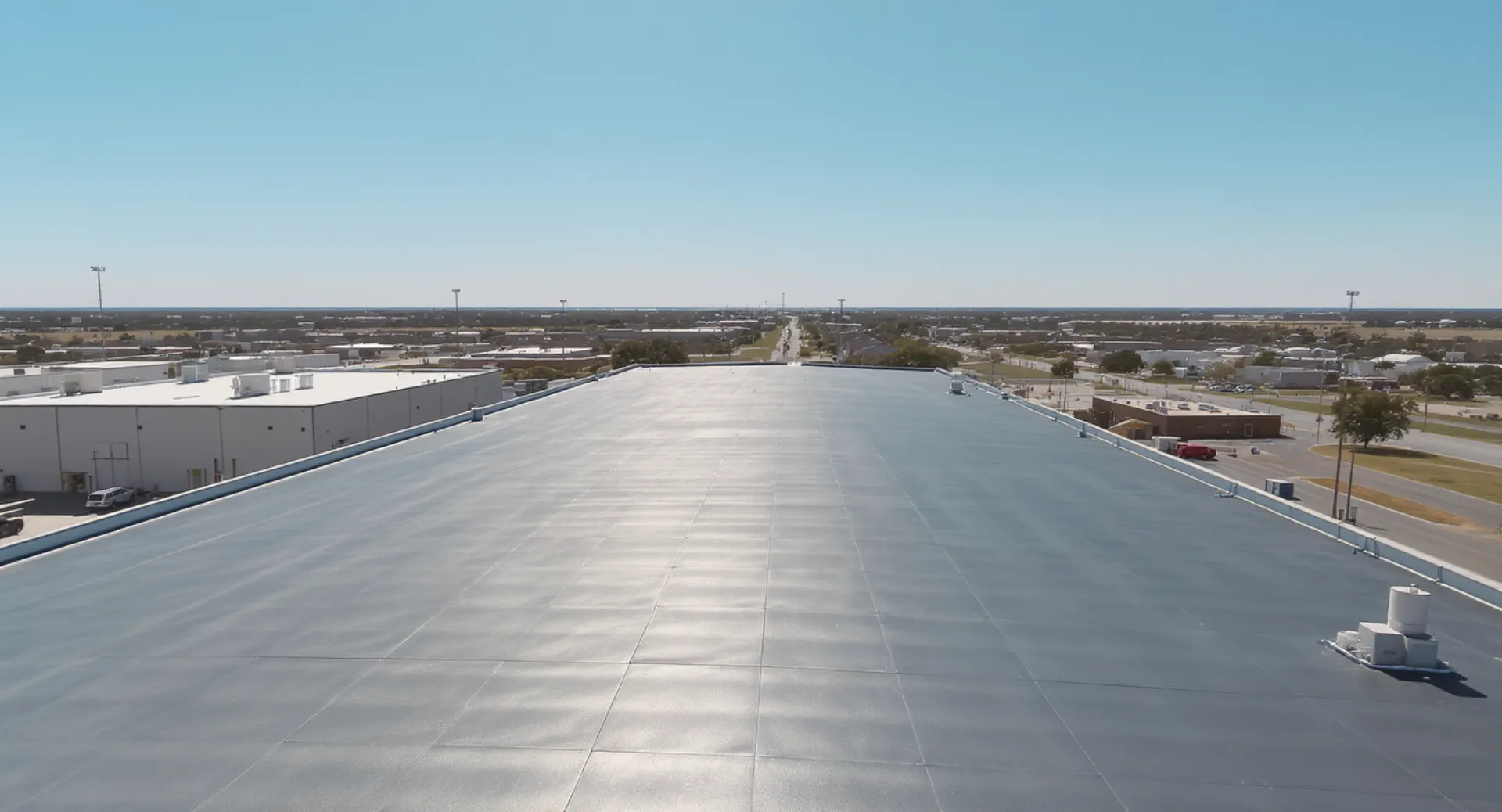
Modified bitumen has been installed on commercial roofs since the 1970s, and it earns its continued place in the specification because of one characteristic single-ply membranes cannot match: layered redundancy. A two-ply mod bit system consists of a base sheet and a cap sheet, each a reinforced asphalt membrane. A seam failure in the cap sheet does not immediately produce a leak — the base sheet intercepts the water. That margin for error matters on a building where a roof call at 2 a.m. during a Panhandle ice storm means real operational disruption.
The modifier in the asphalt — either SBS (Styrene-Butadiene-Styrene) or APP (Atactic Polypropylene) — determines how the membrane behaves at temperature extremes. SBS is rubber-modified: it stretches under load and returns to shape, remaining flexible at temperatures where unmodified asphalt would crack. APP is plastic-modified: stiffer, with a higher softening point and better UV surface stability. For the Panhandle, SBS is the correct primary specification. Amarillo records roughly 10 freeze-thaw cycles per year and winter lows regularly reach the single digits. APP in cold weather becomes brittle — it will crack under the impact of a 2-inch hailstone at 20°F in a way that SBS will not.
The granulated cap sheet is the visible surface of most mod bit systems, and the granules do more than protect against UV. In hail impact testing, mineral granules absorb and disperse energy before it reaches the bitumen layer beneath. FM SH (Severe Hail) ratings — achieved by two-ply SBS systems over a half-inch cover board — are specified for the same reason ASCE 7 Exposure Category C wind loads are specified here: because the Panhandle delivers the design condition, not a statistical outlier.
Installation methods vary by application. Hot asphalt mopping produces the most continuous adhesion and the longest body of FM wind-uplift data. Self-adhered base sheets — factory-applied adhesive backing, no torch, no kettle — are the right choice for occupied buildings and re-roof projects where fire watch is impractical. Torch application delivers fast, strong seams on new construction industrial sites but requires controlled conditions and a documented fire watch. Cold-process adhesive is a viable middle path for recover projects where hot asphalt would be disruptive.
- System Configuration
- 2-ply base + granulated cap
- Modifier Type (Primary)
- SBS (rubber) | APP (plastic)
- Reinforcement
- Polyester or fiberglass mat
- FM Wind Uplift Range
- 1-60 to 1-90 psf
- FM Hail Rating
- SH (with cover board)
- UL 2218 Impact Class
- Class 4 — assembly dependent
- Typical Service Life
- 20–30 years
- Cover Board
- ½-in gypsum or HD polyiso
- Installation Methods
- Hot mop / self-adhered / torch / cold-process
- 2013 Amarillo hailstorm insured losses
- 500M
- Avg freeze-thaw cycles per year in Amarillo
- 10
- Years service life — two-ply SBS system
- 30+
Where Modified Bitumen Earns Its Specification
Modified bitumen is not the right system for every commercial building, but there are categories where it consistently outperforms single-ply alternatives. Re-roofing over an existing built-up roof (BUR) is the clearest example. Mod bit base sheets can be mechanically fastened through the existing BUR system to the steel deck beneath, providing the wind uplift connection that a loose-applied or ballasted recover cannot. BUR-to-mod-bit is a documented, code-compliant recover path that avoids full tearoff — a significant cost and schedule consideration for a 50,000-square-foot industrial building.
Industrial facilities benefit from the system's robustness under foot traffic. Rooftop HVAC servicing, piping runs, and equipment access are realities on industrial roofs; granulated cap sheet absorbs that incidental traffic load in a way that smooth single-ply membrane does not. The polyester reinforcement mat in the cap resists puncture, and a dent in granulated mod bit does not become a leak path the way a puncture in an unreinforced membrane can.
For mid-tier commercial budgets — retail, light industrial, municipal buildings — two-ply SBS mod bit hits a cost-performance point that makes sense when the FM SH hail rating is required and the full-adhered 80-mil TPO budget isn't available. The system uses proven materials and installation techniques that any qualified local crew can execute without specialized equipment.
Mod bit also integrates cleanly with roof coatings at mid-life. A white reflective coating applied over a smooth-surface cap sheet adds 10–15 years of service, converts a dark absorptive surface to a cool roof, and dramatically reduces the thermal cycling stress that causes long-term seam fatigue. That two-phase approach — install mod bit, coat at year 10–12 — is a rational asset management strategy for a building in a hail-heavy market where replacement will eventually require removing and disposing of the old system.
Engineering the Assembly for Panhandle Wind and Hail
A modified bitumen membrane is only as good as the assembly it sits in. The two design loads that govern every commercial roof specification in Amarillo are wind uplift and hail impact — and the Panhandle makes both demands simultaneously, often in the same storm system.
Wind uplift engineering for mod bit starts with the base sheet attachment. A mechanically fastened base sheet — fasteners and plates driven through the insulation into the steel deck — provides the primary uplift resistance. Fastener density at the roof perimeter and corners (ASCE 7 Zones 2 and 3) must be increased from the field pattern because corner uplift pressures are highest. For the Panhandle, with ASCE 7 design wind speeds of approximately 110–125 mph for Risk Category II structures and Exposure Category C terrain (open, flat — which describes most of the High Plains), field areas typically require FM 1-90 rated assemblies; perimeter zones often demand FM 1-120. Edge metal must meet ANSI/SPRI ES-1 test requirements — the IBC mandate for perimeter securement that prevents progressive edge-metal-led roof loss in high winds.
Hail protection in a mod bit assembly comes from the full stack: cover board, base sheet, and granulated cap sheet working together. A half-inch gypsum roof board or HD polyiso cover board between the primary insulation and the base sheet significantly improves FM hail ratings by providing a rigid substrate that doesn't compress under ice-ball impact. Two-ply SBS over gypsum cover board achieves FM SH — tested at sub-freezing temperatures with 2-inch ice balls, which is the relevant condition for a Panhandle building facing a March hailstorm with sub-40°F ambient air.
The surface temperature of a dark mod bit roof in Amarillo's summer sun — at 3,607 feet elevation where UV intensity runs measurably higher than coastal Texas — can exceed 160°F. That heat accelerates bitumen oxidation and surface cracking over time. Specifying a reflective granule cap sheet, or planning for a white coating application at mid-life, addresses this directly without compromising the wind or hail performance of the assembly. See also our TPO roofing and EPDM roofing pages for comparison with single-ply alternatives.
The Details That Separate a 20-Year Roof from a 10-Year Roof
Modified bitumen failures are almost always traceable to specific installation decisions, not to the system's inherent design. The seam between the cap sheet and the base sheet at laps, the flashing at penetrations and curbs, and the termination at the perimeter edge — these are the three zones where the majority of leaks originate. Getting them right is a craft and process question, not a materials question.
Seam adhesion in hot-mopped systems requires maintaining asphalt temperature within the specified range — too cold and the asphalt stiffens before full penetration into the base sheet surface; too hot and polymer modification degrades. In self-adhered systems, surface temperature and substrate cleanliness are the critical variables; installing over dusty, oily, or frost-covered insulation board produces seams that look fine and peel under the first freeze-thaw cycle. Both failure modes are preventable with process discipline and appropriate inspection.
Flashing at penetrations — HVAC curbs, pipe stacks, conduit, drain bodies — is where modified bitumen systems require the most attention on complex commercial roofs. Granulated cap sheet is not flexible enough to wrap tight-radius details; base sheet flashing plies that pre-wrap the penetration before the cap is installed are the correct approach, not single-ply cap sheet cut and folded. Every penetration on a mod bit roof should have a minimum two-ply flashing assembly.
For building owners considering commercial roof repair on an aging mod bit system, or evaluating whether repair or full commercial roof replacement makes economic sense, the decision turns on two factors: how much of the insulation is wet (determined by infrared moisture survey and core cuts) and how many roof layers are already present. Texas code limits structures to two total layers; a building with one mod bit recover already installed must tear off before a new system can go on. That condition changes the economics materially. SDVOSB government contractors can learn more about our federal contracting capabilities at our government roofing page.
Modified Bitumen Roofing — Common Questions
- Modified bitumen is an asphalt-based membrane reinforced with polyester or fiberglass mat, with a polymer modifier — either SBS (rubber-type) or APP (plastic-type) — blended into the asphalt. Unlike a single-ply TPO or EPDM membrane that installs as one layer, a mod bit system is built up in two or more plies: a base sheet and a granulated cap sheet. That layered construction is the defining advantage — if a seam or pinhole develops in one ply, the layer beneath still holds water out.
- SBS for most Panhandle applications. The rubber modifier keeps SBS flexible at low temperatures — important here because Amarillo records roughly 10 freeze-thaw cycles per year and winter lows can reach the single digits. APP (plastic modifier) has a higher softening point and better UV surface stability, but it becomes rigid in cold weather and is more likely to crack under hail impact when temperatures are below freezing. A hybrid system — APP cap sheet over SBS base — can capture the UV benefits of APP while keeping the cold-weather toughness of SBS underneath.
- Two-ply SBS over a half-inch gypsum cover board regularly achieves FM SH (Severe Hail) ratings — the second-highest FM class, designed to withstand 2-inch ice-ball impacts at sub-freezing temperatures. The granulated cap sheet is the first line of defense: mineral granules absorb and disperse impact energy before it reaches the bitumen. The rubber-modified SBS layer beneath dents and rebounds rather than cracking, which is why mod bit outperforms APP in cold-weather hail events. After the May 2013 Amarillo hailstorm — which produced baseball-sized hail and caused an estimated $500 million in insured losses — granulated cap sheet systems showed significantly less functional damage than smooth-surface membranes in the same hail track.
- Yes, under the right conditions. The International Building Code limits most buildings to two total roofing layers. If a structure has only one existing layer, a mod bit recover is permissible — provided an infrared moisture survey and core cuts confirm that the existing insulation is dry (less than 25% saturation) and the deck is structurally sound. Over a wet or deteriorated existing system, full tearoff is required. Mod bit is particularly well-suited for recovering over aged BUR (built-up roofing) systems because the base sheet can be mechanically fastened through the existing system to the deck.
- The most common failure points are seams, perimeter edge details, and surface degradation. Seams in hot-mopped or torch-applied systems fail when adhesion is incomplete — rushed installations in cold weather are a frequent cause. Perimeter edge metal that doesn't meet ANSI/SPRI ES-1 wind ratings can peel away in a 70+ mph wind event, pulling the membrane with it. On the surface, dark smooth cap sheets absorb heat at 3,607 feet of elevation, accelerating asphalt oxidation; a white granule or reflective coating over the cap sheet extends service life meaningfully.
- A properly installed two-ply SBS system with granulated cap sheet typically delivers 20–30 years of service. That range depends on installation quality, drainage conditions, and maintenance. A documented semi-annual inspection program — standard for most manufacturer warranties — catches seam lifting and flashing deterioration early, when repairs are straightforward. Applying a reflective coating over the cap sheet at mid-life can add another 10–15 years by reducing thermal stress and UV breakdown.
- Yes. Texas Department of Insurance regulations require insurers to offer premium credits for roofing materials that achieve UL 2218 Class 4 impact resistance — the highest rating. Two-ply mod bit assemblies with granulated cap sheet can qualify at Class 4, which typically earns a 20–35% premium reduction for commercial properties in high-hail zones like the Panhandle. Documentation required includes the product's UL listing, a copy of the installation invoice specifying the system, and TDI Form PC068.
- Torch-applied mod bit requires open flame and a fire watch, which creates scheduling and liability considerations in occupied buildings. For occupied facilities — offices, schools, healthcare — self-adhering base sheets and cold-process adhesive cap sheets eliminate the open-flame risk while still building up the same two-ply redundancy. Self-adhered systems have improved substantially and are now preferred for retrofit and occupied-building applications. Torch application remains appropriate for new construction and unoccupied industrial facilities where the site can be controlled.
What is modified bitumen roofing and how is it different from a single-ply membrane?
Is SBS or APP modified bitumen better for the Texas Panhandle?
How does modified bitumen perform against Panhandle hail?
Can a modified bitumen roof be applied over an existing roof?
What causes modified bitumen to fail prematurely?
How long does a commercial modified bitumen roof last in Amarillo?
Does modified bitumen qualify for TDI insurance premium discounts in Texas?
Is torch-applied modified bitumen appropriate for occupied commercial buildings?
Work With Us
Put a certified SDVOSB roofing contractor on your bid list.
SDVOSB and Mule-Hide certified — ready for government, industrial, and commercial projects across the Texas Panhandle.
SDVOSB set-aside eligible — Government contracting capabilities →