Commercial Roofing Services
Commercial Roof Repair
Systematic leak diagnosis, emergency wind and hail response, and durable repair work for flat, metal, and membrane roofs across Amarillo and the Texas Panhandle — with written scope before any work begins.
Finding the Actual Leak — Not Just Where the Water Came In
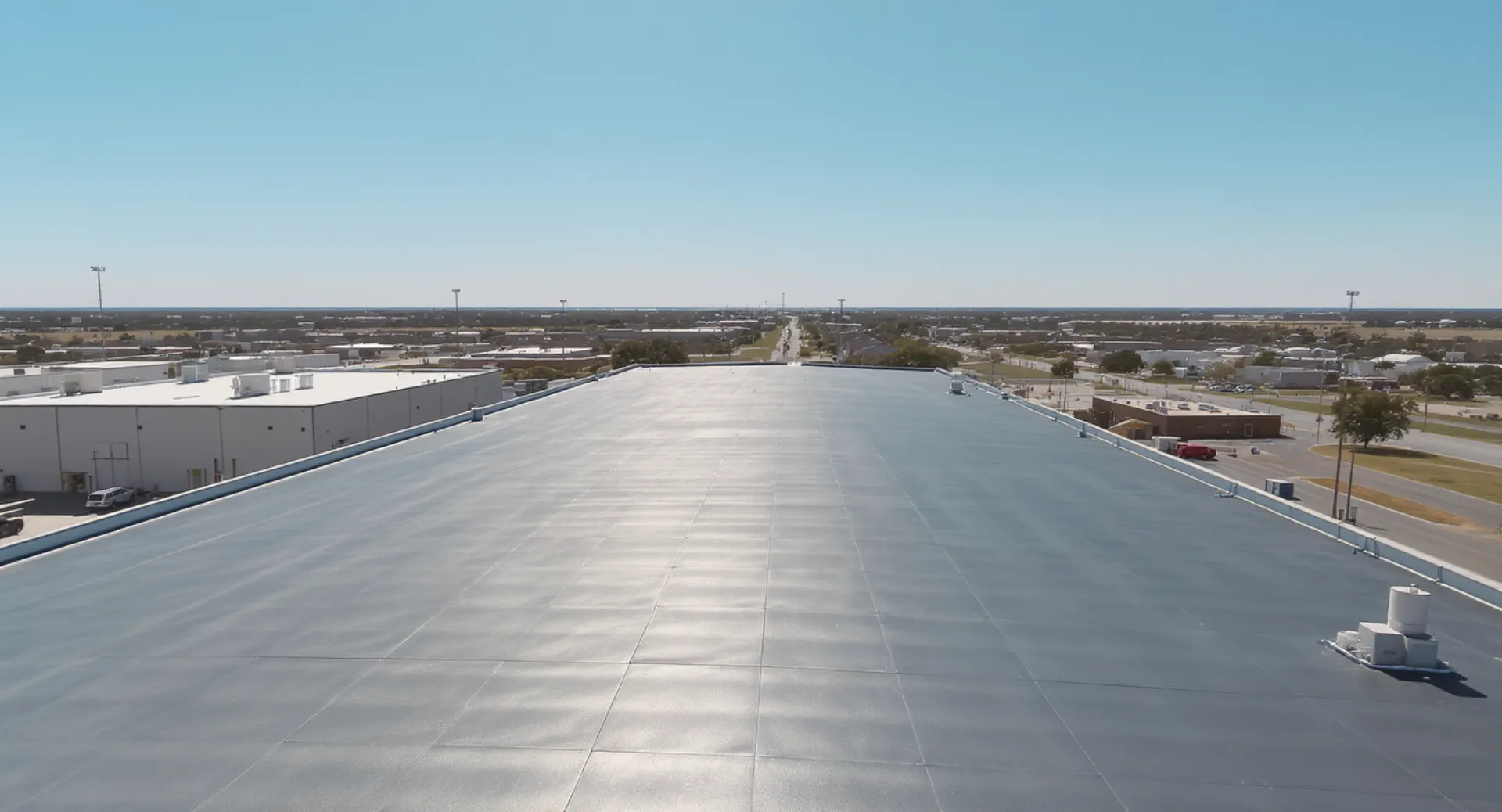
The ceiling stain is rarely directly below the roof breach. On a commercial building with a flat roof and rigid insulation assembly, water enters at one point and travels laterally — sometimes tens of feet — through the insulation before finding a path through the deck and appearing as a ceiling stain or dripping at a light fixture. Chasing the ceiling stain to the roof exterior and patching directly above it is the most common reason commercial roof repairs fail on the second rain: the wrong location was addressed.
Reliable commercial roof repair starts with systematic diagnosis. The exterior inspection covers the high-probability failure zones in order: penetration flashings at HVAC curbs, pipe stacks, conduits, and drains (the highest-frequency leak source on most flat roofs); seam laps and T-joints across the membrane field; perimeter edge metal, coping caps, and counterflashing; and membrane field conditions — blistering, cracking, UV chalking, granule loss on modified bitumen, or evidence of mechanical damage from foot traffic or falling equipment.
When visual inspection doesn't locate the source — particularly on older roofs with complex membrane histories — an infrared moisture survey provides the next level of information. Performed at dusk or after dark, when the sun-heated building has begun to cool, damp insulation holds its heat longer than dry insulation and appears as warm zones in thermal imaging. ASTM C1153 governs the method. The survey is non-destructive and typically completes on a large commercial roof in a single evening. Core cuts at the locations the survey flags — small plug samples removed for physical inspection — confirm moisture depth, which layers are affected, and whether the deck beneath is compromised.
That diagnostic sequence — visual inspection, infrared survey, core cuts — produces a written repair scope with defined boundaries, not an estimate based on best guess. For insurance claims following hail or wind events, the same documentation — photos with timestamps, written inspection report, infrared survey results if conducted — creates the evidentiary record that supports the claim. After a significant Panhandle hail event, that documentation needs to exist before secondary damage (from subsequent rains entering through hail-caused breaches) makes the original damage boundary difficult to establish.
- Leak Diagnosis Method
- Visual inspection + infrared survey (ASTM C1153)
- Moisture Confirmation
- Core cuts — 4–6 in. plug samples
- Emergency Response
- Temporary stop within ~24 hrs of site access
- Repair Scope Output
- Written scope with boundaries before work begins
- Membrane Systems Serviced
- TPO / EPDM / PVC / Mod Bit / BUR / Metal
- Mule-Hide Warranty Eligible
- TPO, EPDM, PVC repairs by certified installer
- Repair Threshold (Area)
- < ~25% wet insulation → targeted repair viable
- Two-Layer Rule
- IBC max 2 roofing layers — layer count confirmed
- Insurance Documentation
- Photo log + written report for claims support
- 2013 Amarillo storm insured losses — repair demand driver
- 500M
- Freeze-thaw cycles / year — primary seam stress driver
- 10
- MPH gusts during severe weather events
- 70+
Wind and Hail Event Response — What to Do and When
The Texas Panhandle is not a region where severe weather is a rare event to prepare for. Amarillo sits at the southern end of Hail Alley — the corridor from North Texas through Kansas where Gulf moisture meets Rocky Mountain cold fronts to produce the country's most violent convective storms. The city averages approximately 13.6 mph sustained wind (second-highest in the US, behind only Dodge City, Kansas), and severe weather events regularly produce sustained winds above 70 mph. Commercial building owners here manage storm damage as a recurring operational condition, not an exceptional one.
The May 28, 2013 hailstorm is the reference event in Amarillo's insurance and property management community: baseball-sized hail, an estimated $500 million in insured losses, and damage to roughly 75% of residential structures in the city. Commercial roof damage from that event ranged from granule loss on modified bitumen surfaces — which accelerated UV degradation over the following years — to punctures in single-ply membranes and cracked PVDF factory finish on metal roofs. Many of those commercial roofs that were not actively leaking in 2013 became repair calls in 2015–2018 as the secondary degradation from compromised surfaces progressed.
The practical protocol for a building owner after any significant hail event is to schedule a documented inspection within 5–10 business days. Not because the roof is necessarily leaking — it may not be — but because most commercial insurance policies have a claim-filing window, and damage that is documented promptly with timestamps and photos is substantially more straightforward to claim than damage discovered months later when the original impact pattern has been obscured by subsequent weathering. An inspection report from a qualified contractor, produced within that window, is the documentation the adjuster requires.
Wind event response focuses on a different failure mode: edge metal displacement and membrane pullback from the perimeter. In high-wind events on flat commercial roofs, the highest uplift pressure is at the corners and perimeter edges — precisely where the IBC requires ANSI/SPRI ES-1 rated edge metal that is tested to resist that load. On buildings where the edge metal does not meet ES-1 ratings for the Panhandle's design wind speed, a strong March storm can peel the edge metal away and begin unzipping the membrane inward from the perimeter. Emergency response to that condition — securing the perimeter before the next weather event continues the damage — is time-critical in a way that interior leak repairs often are not.
Repair or Replace — How the Decision Gets Made
The repair-versus-replace question has a structured answer when the diagnostic data is available. It is not a judgment call made by looking at the roof from the parking lot. Two numbers drive the decision: the percentage of the roof area with saturated insulation, and the remaining service life of the existing membrane.
When an infrared survey and core cuts show wet insulation in less than approximately 25% of the roof area, and the membrane has at least half its expected service life remaining, targeted repair of the wet sections — removing and replacing the damaged insulation, repairing or patching the membrane breach, and restoring the surface above — is the rational path. The sound portion of the roof continues in service; the repair cost is a fraction of full replacement. A roof coating applied over the repaired and sound field after the wet sections are addressed can extend the whole system's service life while the economics remain favorable.
When wet insulation covers more than 25% of the area, or the membrane is at or past end of service life, the economics of repeated repair spending versus a single replacement investment shift. Replacing insulation piecemeal over multiple repair cycles costs more in aggregate than a single tearoff and replacement, without delivering the warranty reset and performance upgrade that a new system provides. The commercial roof replacement page addresses that path in detail.
The layer-count issue is a hard constraint. The International Building Code limits most commercial structures to two total roofing layers. A building that already has one recover installed — original membrane plus one layer over it — cannot have a second recover applied; the next work must be full tearoff. This affects the repair-versus-replace calculation because repair on a two-layer building only addresses the surface; when replacement eventually happens, the cost includes removing both existing layers. Confirming layer count via core cuts as part of the diagnostic process is standard on any building with a roofing history that isn't fully documented.
Systems We Repair and How Repairs Are Executed
Commercial roof repair work spans multiple system types, each with its own repair methodology. The common thread is using compatible materials — the same membrane chemistry as the existing system — and following manufacturer-approved repair procedures when a warranty is in force.
Single-ply membrane repair — TPO, EPDM, PVC — involves cleaning the affected area, cutting back compromised membrane to sound material, and installing a compatible membrane patch that extends a minimum of 6 inches beyond the repair boundary on all sides. TPO and PVC patches are heat-welded for a seam that is stronger than the membrane itself when properly executed. EPDM patches are bonded with EPDM-compatible bonding adhesive and lap sealant. Penetration flashings in single-ply systems are addressed with pre-molded or fabricated flashing collars that seal the membrane to the curb or pipe. As a Mule-Hide certified installer, repairs to Mule-Hide TPO, EPDM, and PVC systems use compatible Mule-Hide materials in a format that maintains warranty eligibility.
Modified bitumen repair uses compatible base sheet and cap sheet material. Failed seams are cleaned and re-adhered with compatible modified bitumen adhesive or torch-applied cap strip, then sealed. Granule loss areas on cap sheet are addressed with granule-surfaced cap sheet patches; smooth cap sheet receives a compatible coating. Penetration flashings receive two-ply patch assemblies — base sheet ply plus cap — that rebuild the full system detail.
Metal roof repairs address seam deformation, clip engagement failures, penetration flashing deterioration, and surface finish degradation. Panels with compromised seams may require re-seaming with a mechanical seaming tool; clip connections that have loosened from thermal cycling may require clip replacement at the affected fastener pattern. Surface coating repairs — sealing hail micro-cracks in PVDF finish with compatible silicone or urethane coating — are addressed in our roof coatings program. After repair, the commercial roof maintenance program provides the semi-annual inspection and documentation cycle that preserves warranty coverage and catches the next failure before it becomes a significant water entry event. Federal facilities across the Panhandle are eligible for SDVOSB set-aside service through our government contracting program.
Commercial Roof Repair — Common Questions
- Interior water entry points are rarely directly below the roof breach — water travels laterally through insulation before finding a path down through the deck. Tracing from the ceiling stain to the actual leak source requires a systematic exterior inspection. We start at the most common failure points: penetration flashings at HVAC curbs, pipe stacks, conduit, and drains; seams at laps and T-joints; and perimeter edge metal. On larger or older roofs where the entry point isn't obvious from visual inspection, an infrared moisture survey locates areas of wet insulation — which retain heat from the day's solar loading and show as warm zones against cooler dry areas when surveyed after dark. Core cuts at the suspect locations confirm moisture depth and which layers are affected. That diagnostic sequence — visual, infrared, core cut — produces a repair scope rather than a guess.
- Document before anything else. Walk the accessible roof as soon as it's safe — ideally within 24–48 hours — and photograph the condition: seam lifting, punctures, displaced edge metal, damaged HVAC curbs, granule accumulation in drains. Date-stamp photos with your phone. This documentation is the foundation of an insurance claim; damage that can be photographed immediately after a storm is substantially harder for an adjuster to attribute to prior deterioration. Then contact a qualified roofing contractor for a formal written assessment. After the May 2013 Amarillo hailstorm produced $500 million in insured losses, many commercial building owners discovered their policies contained impact-resistance premium credits that required documented UL 2218 Class 4 installation — gathering that installation documentation before a storm is the right preparation for the next one.
- The two governing factors are moisture extent and remaining membrane life. If the infrared survey and core cuts show wet insulation in less than roughly 25% of the roof area, and the membrane has at least half its expected service life remaining, targeted repair of the damaged sections plus a coating of the sound field is typically the rational economic choice. If wet insulation covers more than 25% of the area, or the membrane is at or past end-of-service-life, replacement delivers better long-term value than repeated repair spending. A third factor is layer count: buildings with two existing roofing layers cannot be recovered under the IBC — they require full tearoff, which resets the economics toward replacement even when the existing membrane condition might otherwise support repair.
- Emergency temporary repairs — covering an active breach with compatible membrane patches or tarping to stop water entry — can be executed in most conditions. Permanent repairs require dry conditions for adhesive-based systems and temperatures above the product minimum for most single-component sealants and coating-type repairs. Self-adhered patch material has a lower temperature limit than hot-applied methods. In the Panhandle's winters, with lows that reach single digits and spring storms that arrive with cold fronts, permanent repairs to single-ply or mod bit systems may need to be sequenced around temperature windows. Any temporary patch installed in adverse conditions should be documented and followed up with permanent repair when conditions allow.
- We service the full range of commercial low-slope systems: TPO, EPDM, PVC single-ply; modified bitumen (SBS and APP, all installation methods); BUR (built-up roofing); standing seam and structural metal panels; and existing coating systems. Mule-Hide certification for TPO, EPDM, and PVC means we can execute repairs to those systems using compatible Mule-Hide materials in a way that preserves existing Mule-Hide system warranties where applicable. Metal repairs range from seam re-sealing and fastener replacement to clip system re-engagement and penetration flashing replacement.
- Straightforward repairs — a failed seam section, a penetration flashing replacement, a membrane patch at a drain collar — can typically be completed in a day. More complex repairs that require infrared survey, core cut analysis, wet insulation replacement, and membrane patching over a larger area may take several days depending on scope. Emergency response to an active leak can usually produce a temporary stop within 24 hours of access to the site. Permanent repair scope and timeline are confirmed in writing after the diagnostic inspection, before work begins.
- It depends on the warranty terms and who performs the repair. Most manufacturer system warranties — including Mule-Hide NDL (No Dollar Limit) premium warranties — require that modifications, penetrations, and repairs be performed by a warranty-eligible certified contractor using approved materials. Repairs made by an uncertified contractor, or using incompatible materials, can void the warranty coverage on the repaired section or the entire system. As a Mule-Hide certified installer, we can execute repairs to Mule-Hide TPO, EPDM, and PVC systems using compatible materials and document the repair in a format that supports the warranty record. Non-Mule-Hide repairs should be reviewed against the specific warranty language for the system involved.
- Panhandle commercial roofs fail in a predictable pattern driven by the regional climate. Seam lifting and adhesion failure after freeze-thaw cycling is the most common single-ply problem — Amarillo's roughly 10 freeze-thaw crossings per year repeatedly stress the adhesion layer at laps, and mechanically fastened systems develop flutter between rows that eventually fatigues the seam. Perimeter edge metal displacement from 70+ mph wind events is the second most common call — edge metal that isn't ANSI/SPRI ES-1 rated for this wind zone can peel away in a March windstorm, starting progressive membrane loss from the perimeter inward. Penetration flashing failure at HVAC curbs is third — improper flashing details at installation are revealed by freeze-thaw cycling within the first few seasons.
How do you find where a flat commercial roof is leaking?
What should I do immediately after a hailstorm or wind event on my commercial building?
When does it make more economic sense to repair versus replace a commercial roof?
Can a commercial roof with active leaks be repaired in cold or wet weather?
What roofing systems can Centennial Shield repair?
How long does a commercial roof repair take?
Will repairing my commercial roof preserve the manufacturer's warranty?
What are the most common commercial roof repair needs in the Panhandle?
Work With Us
Put a certified SDVOSB roofing contractor on your bid list.
SDVOSB and Mule-Hide certified — ready for government, industrial, and commercial projects across the Texas Panhandle.
SDVOSB set-aside eligible — Government contracting capabilities →