Roofing System — Single-Ply Thermoset
EPDM Rubber Roofing for Commercial Properties in Amarillo
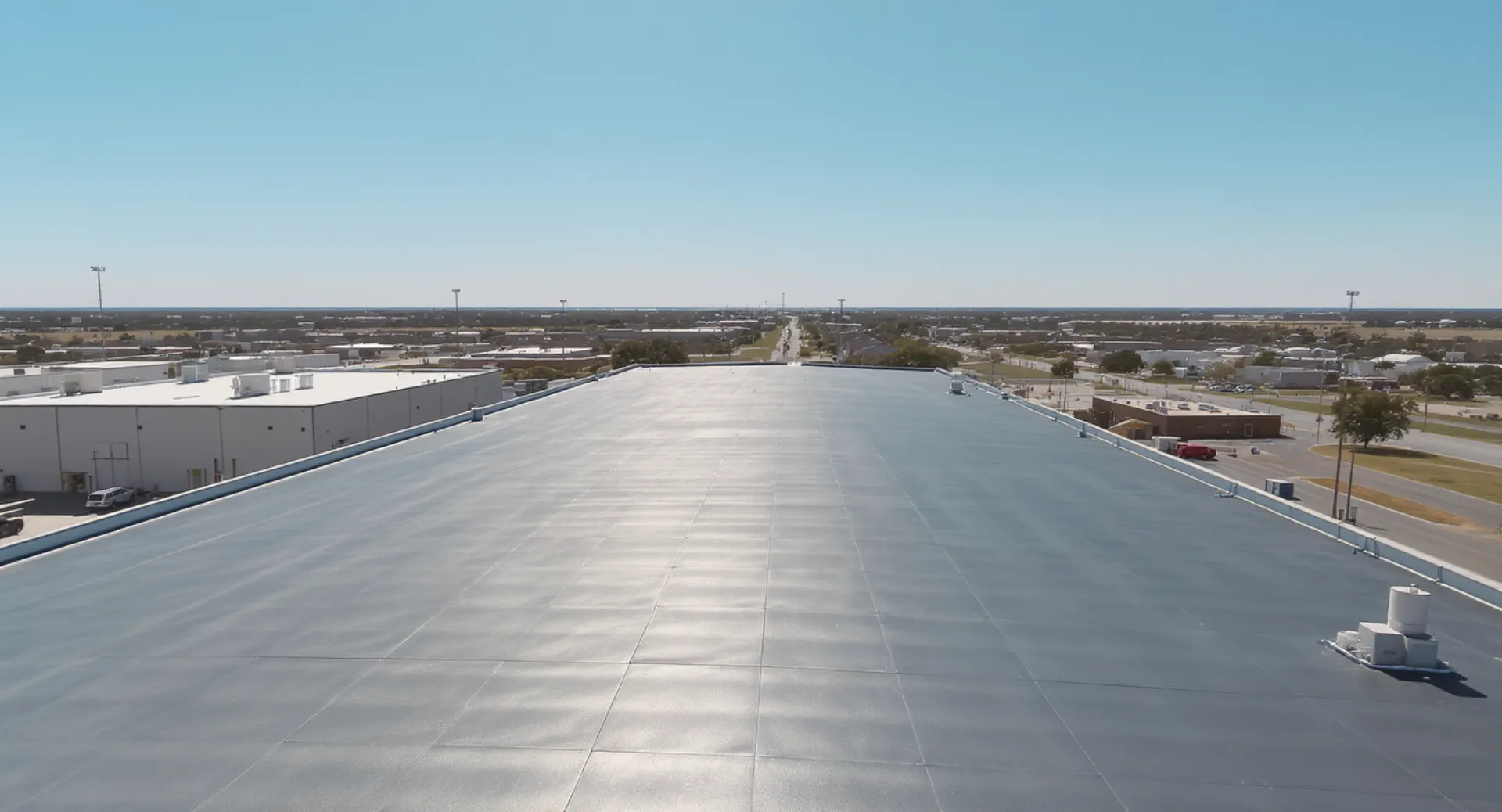
Thermoset rubber membrane with 25–35 year design life. Inherent UV and ozone resistance. Elastic impact recovery. Specified fully adhered for Panhandle wind loads — never ballasted.
- Max Estimated Service Life — 90 mil
- 35 yr
- FM Wind Uplift — Fully Adhered Assembly
- 90 psf
- Freeze-Thaw Cycles — Amarillo (NOAA)
- 10/yr
- Amarillo Elevation — UV Exposure Factor
- 3607 ft
EPDM in the Texas Panhandle: Freeze-Thaw Durability and UV Stability
EPDM (Ethylene Propylene Diene Monomer) is the most-installed commercial low-slope membrane in North America by total square footage. The reason is straightforward: the thermoset rubber polymer backbone — cross-linked at the molecular level — resists UV radiation, ozone, and oxidation better than any thermoplastic membrane. That resistance does not depend on surface color or granule protection. The polymer itself is inherently UV-stable. At Amarillo's 3,607-foot elevation, where UV intensity is measurably higher than at sea level, this chemistry matters over 30-year service horizons.
NOAA Engineering Weather Data for Amarillo (Station WMO 723630) records approximately 10 freeze-thaw cycles per year — the number of times ambient temperature crosses 32°F. Annual temperature extremes run from roughly -10°F to 110°F, a 120°F total swing. EPDM rubber remains flexible at sub-freezing temperatures in a way that thermoplastic membranes do not. This elasticity is the critical performance characteristic in freeze-thaw environments: as the substrate expands and contracts with temperature, an elastic membrane accommodates that movement. A stiffer membrane accumulates stress at fixed points — fasteners, seam edges, flashing terminations — until something gives.
For hail specifically, EPDM's elastic impact recovery is its defining advantage. On hail impact, the rubber deforms and rebounds rather than cracking or puncturing. The caveat is temperature: at sub-freezing temperatures, all rubber becomes less elastic. Large hail on a cold winter roof — a scenario that occurs in the Panhandle — is harder on EPDM than the same hail on a warm summer roof. Fully adhered 60-mil or 90-mil EPDM over HD polyiso cover board provides the best cold-weather hail resistance in the EPDM product family. The cover board absorbs impact energy before it reaches the insulation below, preventing the insulation compression that leads to post-hail moisture migration.
The wind attachment requirement for Panhandle EPDM is clear: no ballasted systems. Ballast stone at 10–12 psf of 1- to 1.5-inch gravel holds EPDM down by weight in low-wind environments. In Amarillo's open-terrain exposure — ASCE 7 Exposure Category C with design wind speeds of approximately 110–125 mph and documented severe-weather gusts exceeding 70 mph — ballast stone scours at roof edges and exposes membrane. Fully adhered or mechanically attached EPDM with ANSI/SPRI ES-1 perimeter edge metal is the required approach.
System Specifications
- Membrane Thickness
- 45 / 60 / 90 mil
- Polymer Type
- Thermoset Rubber
- Seam Method
- Lap Tape (Pre-taped option)
- Attachment Methods
- Fully Adhered / Mech. Attached
- FM Wind Uplift
- 1-60 to 1-90+ psf
- FM Hail Rating
- MH to VSH (assembly)
- Solar Reflectance (White)
- ~0.70+
- Estimated Service Life
- 25–35 yr (mil-dependent)
- Warranty Availability
- NDL System (60 mil+, certified inst.)
Ballasted attachment not recommended for Panhandle wind exposure. Verify FM assembly listings for project-specific deck and insulation configuration.
Building Types and Sectors Where EPDM Is the Right Call
EPDM's longest service lives — 25–35 years depending on thickness and exposure — make it compelling for buildings with long ownership horizons and limited maintenance budgets. Industrial facilities where freeze-thaw cycling is the primary durability concern (rather than chemical exposure), municipal buildings with deferred replacement cycles, and commercial buildings where the owner wants maximum service life over a 30-year budget horizon are strong EPDM candidates.
Healthcare facilities in the Panhandle — BSA Health System, Northwest Texas Healthcare — represent long-term institutional ownership with occupied-building constraints. EPDM's long design life aligns with healthcare facility planning cycles. The requirement is white or White-on-Black EPDM to meet energy code cool-roof requirements; standard black EPDM is not appropriate for occupied healthcare facilities where cooling loads are significant.
For government and federal buildings — a category where Centennial Shield's SDVOSB certificationopens procurement pathways — EPDM's documented 30+ year track record and the availability of Mule-Hide NDL system warranties satisfy the long-term asset protection requirements common in federal facility management. The Thomas E. Creek VA Medical Center and GSA-managed federal buildings in the region represent exactly the building type where EPDM's longevity and warranty depth match procurement requirements.
EPDM is not the right choice for buildings with chemical or grease exhaust exposure — PVC is better for that application. For new construction where design life of 30+ years is the goal and chemical exposure is not a factor, EPDM at 60- or 90-mil fully adhered is a defensible specification. For projects where the 20-year horizon is sufficient and seam strength is the primary concern, TPO competes effectively.
EPDM Installation: Attachment Methods and Seaming Protocols
The EPDM insulation assembly follows the same basic stack as TPO: steel or concrete deck, vapor retarder where required, staggered-joint polyiso primary insulation, HD polyiso or gypsum cover board, then membrane. The cover board provides the flat, rigid substrate needed for adhesive contact and hail resistance — direct application of EPDM over polyiso without cover board reduces FM hail ratings and is not the recommended specification for Panhandle conditions.
For fully adhered installation, water-based bonding adhesive is applied to both the cover board surface and the underside of the EPDM membrane, allowed to flash off, then the surfaces are rolled together and pressed. Mule-Hide's low-VOC water-based adhesive options satisfy environmental and building occupancy requirements for installations over occupied structures. Mechanically attached EPDM uses batten bars or plates that fasten through the membrane and insulation to the deck — used where adhesive installation is impractical, such as over existing insulation without a suitable bonding surface.
Seaming is where EPDM quality is won or lost. Lap tape seams require thorough surface preparation — membrane surfaces must be clean, dry, and primed at both edges. Mule-Hide's pre-taped EPDM (factory-applied 3- or 6-inch seam tape) reduces field-seaming variability by eliminating the field-applied tape cut and alignment step. All seams are probed and visually inspected after installation; any lifting or insufficient adhesion requires immediate correction before the project is closed out.
EPDM Fleece Back bonds directly to the insulation surface without separate bonding adhesive — the fleece underside bonds to low-rise polyurethane foam adhesive applied to the cover board. This approach speeds installation on large-footprint buildings and is a practical option on re-roof and replacement projects where existing structure and insulation are confirmed dry by infrared survey and core cuts.
Panhandle Performance Engineering: UV, Wind, and Freeze-Thaw
EPDM's UV resistance is its strongest differentiator against thermoplastic membranes over long time horizons. The ethylene propylene polymer backbone does not chalk, embrittle, or oxidize under UV the way TPO surface polymers do over time. At Amarillo's 3,607-foot elevation, where atmospheric UV filtering is reduced compared to sea level, this long-term stability is a meaningful performance advantage. A well-installed 60-mil EPDM system maintained with semi-annual inspections routinely reaches 30 years of service — a track record that the Panhandle's elevated UV conditions make harder to replicate with TPO in equivalent configurations.
Wind performance in the Panhandle requires the fully adhered specification. FM uplift ratings for fully adhered EPDM assemblies reach FM 1-90 in standard configurations. The critical detail is ANSI/SPRI ES-1 edge metal at the perimeter — rated to the project's wind uplift requirements. For Panhandle buildings in Exposure Category C, ES-1 edge metal at FM 1-90 or FM 1-120 equivalent is the typical specification. Edge metal failure is the mechanism that initiates progressive roof loss in wind events — the membrane peels back from the edge inward. Properly specified edge metal is not a secondary detail.
Freeze-thaw cycling affects all roofing systems, but EPDM handles it best at the membrane level. The key engineering consideration in Panhandle applications is not the membrane itself but the flashings: pipe penetration flashings, curb flashings, and parapet counterflashings are the most frequent leak origin points in any membrane system, and thermal cycling stresses flashing terminations more than field membrane. Mule-Hide's EPDM flashing system — uncured EPDM for three-dimensional detail work — is designed to accommodate movement at these critical transition points. Installation quality at flashings determines whether a 30-year roof performs for 30 years or develops leaks at year 8.
Manufacturer Certification
Mule-Hide Certified EPDM Installer
Centennial Shield holds Mule-Hide certification for EPDM installation. This certification is the prerequisite for offering Mule-Hide's Premium NDL system warranties on EPDM projects — coverage that requires 60-mil minimum membrane thickness and certified-contractor installation. NDL (No Dollar Limit) means Mule-Hide pays full repair or replacement cost without amortization for the warranty period. The complete system — membrane, insulation, fasteners, adhesives, and flashings — must be Mule-Hide-supplied or Mule-Hide-approved for NDL coverage to apply.
For government and federal facility projects, manufacturer certification satisfies procurement quality requirements that specify certified-contractor installation. Centennial Shield's SDVOSB status adds the federal set-aside eligibility layer on top of technical certification — a combination that no other Panhandle-based roofing contractor currently offers with a documented web presence.
- Certification Status
- Mule-Hide Certified
- Warranty Tier Access
- Premium NDL
- Min. Mil for NDL
- 60 mil
- Coverage Scope
- System-Wide
- Maintenance Required
- Semi-Annual Inspection
- SDVOSB Status
- SBA VetCert
EPDM Roofing Questions — Amarillo and the Panhandle
- EPDM is a thermoset (rubber) membrane — once cured, the cross-linked polymer cannot be re-melted. This gives it exceptional elasticity: EPDM stretches under impact and load, then rebounds. TPO and PVC are thermoplastic membranes that can be re-melted by heat welding, which is how their seams are made. EPDM seams use lap tape, not heat welding. The practical tradeoff: EPDM has better raw impact elasticity (especially in cold conditions), outstanding UV and ozone resistance, and excellent long-term flexibility. TPO and PVC have stronger seam systems and better chemical resistance. For Panhandle applications where freeze-thaw cycling and UV durability are the primary concerns, EPDM's polymer chemistry is well-suited to the climate.
- No. Ballasted EPDM uses river stone (typically 10–12 psf of 1- to 1.5-inch gravel) placed over the membrane to hold it down by weight. In high-wind zones — Amarillo's sustained winds and 70+ mph gust events — ballast stone scours at roof edges and perimeters, exposing the membrane and initiating progressive failure. Even with perimeter picture-framing (adhered or mechanically attached perimeter zone), full-field ballasted systems are not the correct specification for the Panhandle's open-terrain wind exposure. Fully adhered or mechanically attached EPDM with ANSI/SPRI ES-1 edge metal is the correct approach.
- White EPDM or Mule-Hide's White-on-Black EPDM (reflective white surface layer over standard black EPDM) is the correct specification for most Panhandle commercial applications. Standard black EPDM has a solar reflectance of approximately 0.06 — it absorbs nearly all solar radiation, driving roof surface temperatures above 160°F at Amarillo's elevation. White EPDM achieves approximately 0.70+ reflectance, qualifies as a cool roof, and meaningfully reduces cooling loads. The thermal mass argument for black EPDM (slower heat loss on winter nights) is much weaker than the summer heat gain penalty in the Panhandle's high-UV, high-temperature summer environment.
- EPDM's thermoset rubber structure gives it the best raw impact elasticity of the single-ply membranes — it absorbs impact energy by deforming and recovering rather than cracking or puncturing. In warm conditions, fully adhered EPDM over HD cover board performs well under hail impact. The caveat is temperature: EPDM becomes less flexible below freezing. When large hail hits cold EPDM — a realistic scenario in Panhandle winters with the combination of freezing temperatures and active convective weather — impact damage risk is higher than in warm conditions. A 60-mil or 90-mil specification provides more impact resistance than 45-mil in cold-weather hail events.
- EPDM cannot be heat-welded — the thermoset polymer structure means it does not re-melt. All seams are made with lap tape (uncured EPDM tape or factory-applied pre-tape). The tape seam quality depends on surface cleaning, primer application, tape compression, and temperature at installation. Unlike TPO's molecular weld, a tape seam is a pressure-sensitive adhesive bond. Historically, seam adhesion failure is the leading cause of EPDM membrane leaks. Mule-Hide's pre-taped EPDM products reduce field-seaming variability. Proper surface preparation and certified installer protocols are the most important quality variables in EPDM installation.
- Mule-Hide lists up to 30-year system warranty for EPDM on their product page, with NDL (No Dollar Limit) Premium warranty available requiring certified contractor installation and 60-mil minimum membrane thickness. Specific year tiers and exact coverage terms should be confirmed with current Mule-Hide documentation at warranty application time. As Mule-Hide certified EPDM installers, we submit warranty applications at project completion and provide the written inspection reports required to maintain warranty validity.
- Yes, subject to IBC layer-count restrictions and moisture survey results. If the building has one existing roofing layer and infrared moisture survey plus core cuts confirm the insulation is dry, EPDM over a recover board is a permissible and often cost-effective option. EPDM's low material weight is an advantage on re-cover projects where adding dead load to the structure is a concern. We perform infrared surveys and core cuts before recommending recover versus full tearoff on any re-roof project.
- EPDM is inherently more flexible at sub-freezing temperatures than thermoplastic membranes. At sub-zero temperatures, EPDM rubber retains significant elasticity; TPO becomes stiffer. Amarillo's approximately 10 freeze-thaw cycles per year stress seams and flashings cyclically — each thermal event imposes differential movement between membrane and substrate. EPDM's elastic recovery accommodates this movement without the fatigue stress that accumulates in stiffer materials. However, EPDM's tape seams are more vulnerable to peel stress at freezing temperatures than heat-welded thermoplastic seams. Fully adhered EPDM with carefully executed seam work is the configuration that best leverages the membrane's elasticity while minimizing the seam vulnerability.
What makes EPDM rubber roofing different from TPO or PVC?
Is ballasted EPDM appropriate for commercial buildings in the Texas Panhandle?
Should I specify black or white EPDM for an Amarillo commercial building?
How does EPDM handle the Panhandle's hail exposure?
Why are EPDM seams considered the primary failure risk?
What warranty terms does Mule-Hide offer for EPDM roofing?
Can EPDM be used on a re-cover project over an existing roof in Amarillo?
How does freeze-thaw cycling affect EPDM versus TPO membranes?
Related Roofing Systems and Services
Compare all six roofing systems
TPO RoofingHeat-welded thermoplastic membrane
PVC RoofingChemical-resistant single-ply for food processing and industrial
Commercial Roof ReplacementFull tearoff and new system installation
Roof Maintenance ProgramsSemi-annual inspections to preserve warranty coverage
Government ContractsSDVOSB set-aside eligible — VA, GSA, federal buildings
Work With Us
Put a certified SDVOSB roofing contractor on your bid list.
SDVOSB and Mule-Hide certified — ready for government, industrial, and commercial projects across the Texas Panhandle.
SDVOSB set-aside eligible — Government contracting capabilities →