Commercial Roofing Systems
Roof Coatings
Silicone, acrylic, and urethane coating systems that restore reflectivity, extend membrane life, and reframe the repair-versus-replacement decision — applied over sound substrates before deterioration forces the issue.
What Roof Coatings Are — and Are Not
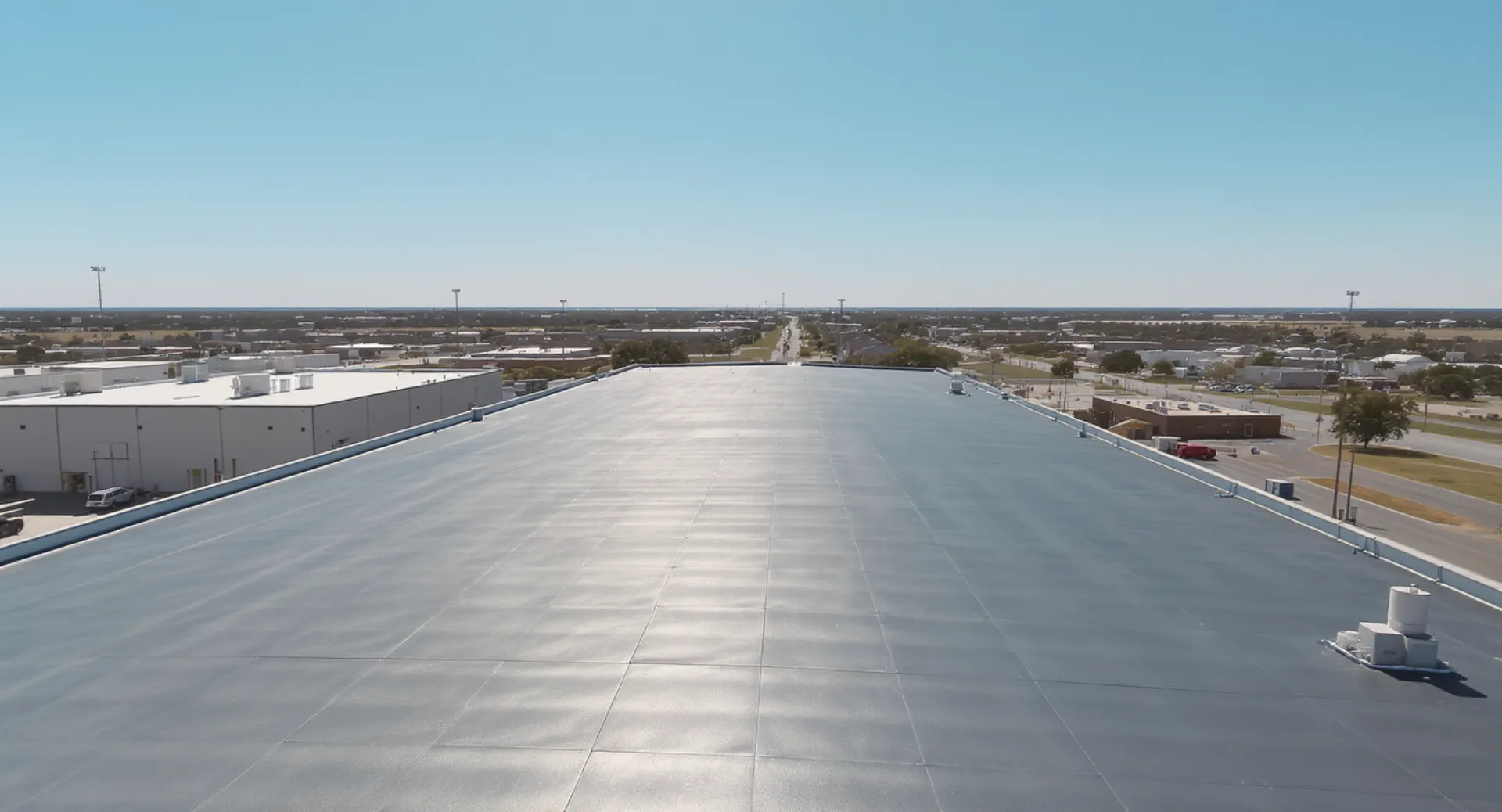
A roof coating is not a roofing system. It is a restoration layer applied over an existing, structurally sound roof — membrane or metal — that extends service life, restores reflectivity, and provides a renewed waterproofing surface. The existing membrane continues to carry the structural and primary waterproofing load. The coating adds UV protection, reflects solar heat, and seals the micro-cracking and surface oxidation that develops as a membrane ages.
That distinction matters for the economics. A coating application over a 12-year-old modified bitumen roof that is still structurally sound — dry insulation, intact seams, good adhesion at penetrations — costs substantially less than tearing off and replacing that roof, and it defers that replacement cost by 10–20 years depending on coating type and application quality. A coating applied over a roof with saturated insulation, failed seams, or membrane at the end of its service life is money wasted; the coating conceals the deterioration but does not address it.
Three coating chemistries are used on commercial roofing in the Panhandle, and they are not interchangeable: silicone, acrylic, and aliphatic urethane. Each has a specific performance profile and a specific use case, defined primarily by drainage conditions and substrate type. Choosing the wrong chemistry for the conditions — most commonly, specifying acrylic on a flat roof that ponds water — produces premature failure and re-spending on a problem that the correct chemistry would have handled.
For the Panhandle specifically, the UV stability of coating chemistry matters more than it does in Dallas or Houston. Amarillo sits at approximately 3,607 feet — the highest major city in Texas — and at that elevation the atmosphere filters measurably less UV radiation per 1,000-foot gain. The practical result is that acrylic coatings, which chalk and lose reflectivity under UV exposure, degrade faster here than at lower elevations. Silicone's siloxane backbone does not respond to UV the same way; it maintains reflectivity and adhesion over a longer service life at this elevation, which is why it is the standard specification for flat commercial roofs in the Panhandle where ponding is possible.
- Silicone — Ponding Resistance
- Excellent — does not re-emulsify
- Silicone — UV Resistance
- Excellent — siloxane backbone stable
- Silicone — Solar Reflectance
- ~0.85–0.90 (CRRC-listed)
- Acrylic — Ponding Resistance
- Poor — re-emulsifies in standing water
- Acrylic — UV Resistance
- Good initially; chalks / fades year 3–5
- Acrylic — Best Application
- Metal roofs with positive drainage
- Urethane — Impact Resistance
- High — seals hail micro-cracks
- Service Life Extension
- 10–20 yr (silicone) | 5–10 yr (acrylic)
- Application Rate
- ~1 gal / 100 SF per coat — two-coat system
- Dry mil thickness — two-coat silicone system
- 20–30
- Years additional service life from proper coating
- 10–20
- Max TDI insurance premium credit — Class 4 + reflective
- 35%
Restoration Economics — When Coating Beats Replacement
The economic case for coating over replacement is straightforward when the conditions are right. Full replacement involves tearoff labor, disposal of the old membrane and insulation, new insulation, new membrane, and the scheduling disruption of a multi-week project on an occupied building. Coating requires surface preparation, seam and flashing repairs, and application — on most commercial buildings, a two-to-three day process. The cost difference is real and significant.
The decision threshold is substrate condition. An infrared moisture survey performed after a significant rain event — when damp insulation shows thermal differential against dry areas during the nighttime cool-down — gives the most useful data. Wet insulation detected by infrared, confirmed by core cuts, must come out; coating over wet insulation traps the moisture, promotes mold growth, and accelerates deck corrosion in steel-deck assemblies. If surveyed area shows less than roughly 25% moisture saturation, coating is a rational path. Above that threshold, targeted replacement of wet sections followed by coating of the remaining sound field is often the best hybrid approach.
Post-hail assessment is where coating decisions become particularly relevant in the Panhandle. The May 2013 Amarillo hailstorm — which caused an estimated $500 million in insured losses — left many commercial roofs with surface damage that was not severe enough to justify immediate replacement but materially shortened remaining service life. Granule loss on modified bitumen cap sheets exposes the bitumen to accelerated UV oxidation. Minor dimpling on metal roofs creates micro-cracks in PVDF coatings at the impact site. Coating applied over these surfaces — silicone on the mod bit, aliphatic urethane on the metal — seals the exposed areas, restores reflectivity, and extends service life. That outcome is economically rational when the alternative is full replacement on a membrane that still has structural integrity.
The connection to modified bitumen systems and metal roofing is direct: both system types are well-suited to coating restoration at mid-life, and planning for that coating application in the original asset management cycle — rather than treating it as an emergency response — produces better outcomes. A dark mod bit surface coated at year 12 with white silicone adds another 15 years of service while converting a heat-absorbing surface to a cool roof. A metal roof coated at year 20 with aliphatic urethane seals the aged factory finish and defers the structural replacement decision by a decade or more.
Silicone vs. Acrylic vs. Urethane — Matching Chemistry to Conditions
The three coating chemistries available for commercial roofing are not competing products in the same market — they solve different problems, and specifying one where another is required produces the wrong outcome regardless of application quality.
Silicone is the specification for flat and low-slope commercial roofs in Amarillo. The defining property is ponding water resistance: silicone does not re-emulsify, soften, or delaminate when water stands on its surface indefinitely. On a commercial building where flat field areas drain slowly or where drain scuppers occasionally get blocked, silicone maintains its adhesion and waterproofing performance. Acrylic does not — it re-emulsifies under 48–72 hours of standing water, softening and losing adhesion at exactly the locations where the roof most needs it. The second reason for silicone on Panhandle flat roofs is UV stability: the siloxane polymer backbone does not chalk or embrittle under UV exposure the way acrylic latex polymers do. White silicone maintains reflectance values near 0.85–0.90 over the service life with minimal degradation; acrylic reflectance typically drops to 0.50–0.65 within 3–5 years as the surface chalks and weathers.
Acrylic is appropriate for metal roofs with positive, fast drainage — a metal building with steep slope, functional gutters, and no areas where water stands. On those substrates and drainage conditions, acrylic's lower cost and ease of application make it a rational choice, particularly for a 5–10 year service-life extension rather than the 15–20 years that silicone can deliver. The key condition is that drainage must be reliable and verified — not assumed.
Aliphatic urethane serves a specific niche: metal roofs that have sustained hail micro-cracking in the factory PVDF finish, or surfaces that see heavy foot traffic from rooftop equipment servicing. Urethane coatings — particularly two-component plural systems — have higher impact and abrasion resistance than silicone or acrylic. An aromatic urethane base coat (high solids, strong adhesion) plus an aliphatic urethane finish coat (UV-stable, color-retentive) is the standard two-coat approach for metal roofs where impact resistance is the primary driver. One practical note on urethane: two-component systems require precise mix ratios at the point of application; quality control in the field matters more than with single-component silicone or acrylic.
Why Substrate Preparation Determines Whether Coatings Last
Coating failure is almost always a preparation failure, not a product failure. Silicone applied at the correct rate to a dirty, chalky, or marginally adhered membrane surface will delaminate within a few seasons — the coating peels off carrying whatever contamination sat between it and the substrate. Preparation is the majority of the work, and cutting time there produces a shorter-lived result that ultimately costs more than a proper application.
The preparation sequence for a modified bitumen substrate: inspect all seams and probe for adhesion; repair any lifted seams or fishmouths with compatible base sheet material and mastic before coating begins; pressure wash the entire surface to remove dirt, chalking, and granule debris; allow to dry completely; apply reinforcing fabric at seams and penetration flashings before coating if an FM or manufacturer warranty system is required. The reinforcing fabric step — embedding polyester mesh in the first coat at seams — is what converts a surface coating into an FM-rated restoration system with warranty coverage.
For metal substrates, rust and surface oxidation must be addressed before coating. Rust spots require wire brushing or grinding to bare metal, followed by a rust-inhibitive primer before coating. Active rust under a silicone or urethane topcoat will continue to propagate and eventually lift the coating. The same logic applies to laps, seams, and fastener heads on metal panel roofing — each fastener head in an exposed-fastener metal system is a potential rust origin and a potential leak point; sealing them with butyl sealant before coating is standard practice.
Building owners planning a coating project should coordinate with their insurance carrier before application. Texas Department of Insurance regulations require specific documentation for premium credits — including UL 2218 ratings and reflectance certification — and coating systems that qualify for cool-roof credits or impact-resistance credits have documentation requirements that must be captured at time of installation. Post-project, the commercial roof maintenance program picks up where the coating installation leaves off: semi-annual inspections document coating condition, catch any areas requiring touch-up, and maintain the manufacturer warranty record. For owners evaluating the full decision tree — coat versus repair versus replace — our commercial roof repair and commercial roof replacement pages address the other two branches. Federal facilities can access these services through our SDVOSB contracting program.
Roof Coatings — Common Questions
- A roof coating is applied over an existing, structurally sound roof membrane or metal surface to extend its service life, restore reflectivity, and seal minor defects. A coating does not replace the underlying roofing system — the existing membrane or metal continues to carry load and provide primary waterproofing. Replacement involves removing the existing system and installing a new one. Coating is appropriate when the substrate is dry, structurally intact, and has reasonable remaining service life; replacement is required when insulation is saturated, the membrane is at or past its service life, or there are two existing roof layers already in place (the IBC maximum).
- For low-slope or flat roofs in the Panhandle where ponding water is a possibility, silicone is the correct specification. Silicone does not re-emulsify in standing water — it maintains its adhesion and waterproofing performance even when water stands on the surface for extended periods. Acrylic coatings soften and degrade under ponding water within 48–72 hours; on any roof where drainage is slow or questionable, acrylic will fail prematurely. Aliphatic urethane is the choice for metal roofs with hail-caused micro-cracking where impact resistance and abrasion resistance matter. Acrylic is appropriate for metal roofs with positive, fast drainage where budget is a constraint.
- A properly applied silicone coating system — two coats at sufficient mil thickness over a clean, dry, prepared substrate — typically extends service life by 10–20 years. That range depends on substrate condition, application rate, and ongoing maintenance. Silicone's UV stability is the key driver: the siloxane polymer backbone does not chalk, embrittle, or break down under UV radiation the way acrylic degrades. At Amarillo's 3,607-foot elevation, where UV intensity is measurably higher than at sea level in coastal Texas, silicone's UV resistance provides its largest relative advantage over acrylic.
- Yes — with an important qualification. Coating is appropriate for roofs where hail impact has caused surface dimpling, granule loss on modified bitumen, or minor oxidation on metal, but where the membrane itself remains waterproof and the insulation beneath is dry. If hailstones have punctured through a single-ply membrane or knocked granules off a mod bit cap sheet to the point of exposed bitumen, those areas require repair with compatible membrane patches before coating is applied. Coating over active leak sites or wet insulation does not solve the underlying problem — it conceals it temporarily while the wet insulation continues to lose R-value and create structural risk. An infrared moisture survey before specifying a coating application is the correct first step.
- The process begins with a thorough inspection and moisture survey to confirm the substrate is dry and suitable for coating. All seams, penetration flashings, and areas showing adhesion failure are repaired with compatible membrane or sealant before coating begins. The surface is cleaned — pressure washing to remove dirt, chalking, and any loose material. Primer is applied where silicone-to-substrate adhesion requires it (metal and some aged membranes). Base coat is applied at the specified rate — typically 1 gallon per 100 square feet — and allowed to cure before the finish coat at the same rate. Total dry film thickness runs approximately 20–30 mils across two coats.
- Yes, measurably. White silicone has an initial solar reflectance of approximately 0.85–0.90 and qualifies as a cool roof under ASHRAE/IECC and California Title 24 (which Texas energy code aligns with for commercial buildings). Converting a dark modified bitumen or metal surface — which can reach 160°F+ on a summer afternoon at Amarillo's elevation — to a reflective surface that stays 50–70°F cooler directly reduces the heat load on the building's HVAC system. The energy savings depend on building insulation levels, occupancy, and HVAC efficiency, but the cooling load reduction from a dark-to-white conversion is a real and calculable number.
- Coating restoration typically costs substantially less than full tear-off and replacement. The exact multiple depends on system type, roof complexity, and local labor markets — but the cost differential is significant enough that for a sound roof at the 12–18 year mark on a 25-year membrane, coating is often the rational economic choice. Full replacement also involves disruption (tearoff generates debris, temporary exposure during work, scheduling around facility operations) and disposal costs. The coating path defers that disruption while locking in another decade or more of service. That said, coating a roof with saturated insulation or significant membrane degradation is wasted money — condition assessment first.
- Silicone is compatible with most commercial substrates: new spray polyurethane foam, EPDM, TPO, aged PVC, concrete, asphalt built-up roofing, granulated modified bitumen, and metal. The substrate must be dry, clean, and have adequate adhesion strength for the coating to bond to. One practical limitation of silicone: future re-coating must also be silicone. Silicone over silicone bonds well; most other coatings do not adhere reliably to cured silicone. That means the re-coating cycle at 10–15 years stays within the silicone product line — plan for that when evaluating the long-term maintenance commitment.
What is the difference between a roof coating and a roof replacement?
Which roof coating — silicone, acrylic, or urethane — is right for a flat commercial roof in Amarillo?
How much life can a silicone coating add to an existing commercial roof?
Can a coating be applied over hail-damaged modified bitumen or TPO?
What is the application process for a commercial silicone roof coating?
Will a reflective roof coating reduce my building's cooling costs in the Panhandle?
How does the restoration economics compare to full replacement for a mid-life commercial roof?
Can silicone coating be applied over any existing roofing membrane?
Work With Us
Put a certified SDVOSB roofing contractor on your bid list.
SDVOSB and Mule-Hide certified — ready for government, industrial, and commercial projects across the Texas Panhandle.
SDVOSB set-aside eligible — Government contracting capabilities →