Roofing System — Single-Ply Thermoplastic
PVC Roofing for Commercial Properties in Amarillo
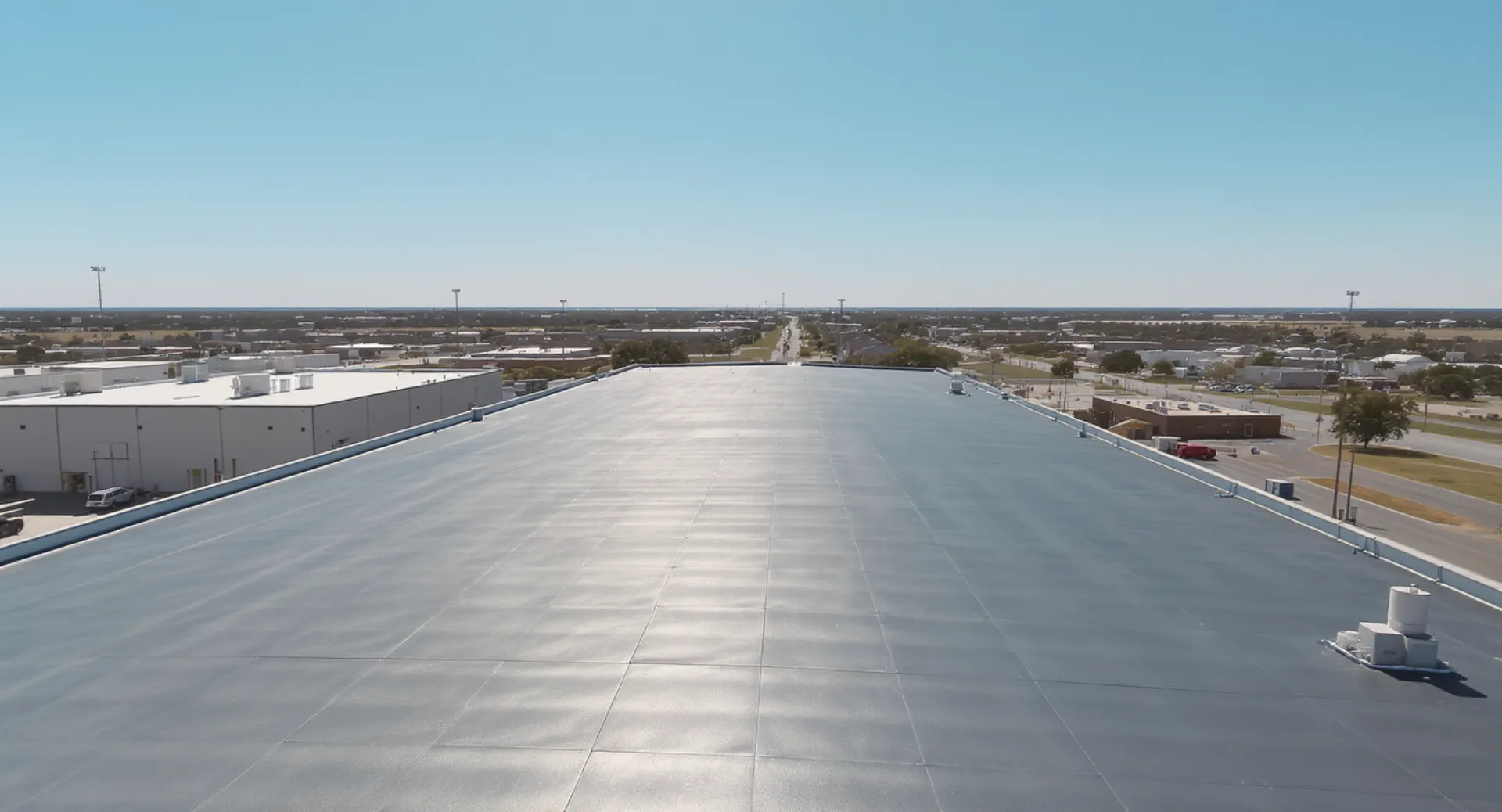
Chemical-resistant polyvinyl chloride membrane with heat-welded seams. The correct specification for food processing facilities, commercial kitchens, and any building with exhaust or chemical exposure on the roofline.
- Max Membrane Thickness Available
- 80 mil
- FM Wind Uplift — Fully Adhered Assembly
- 120+ psf
- Estimated Service Life — 80 mil
- 30+ yr
- 2013 Hailstorm Insured Losses ($) — Amarillo
- 500M
PVC Roofing in the Texas Panhandle: Chemical Resistance Meets Wind and Hail Performance
PVC (Polyvinyl Chloride) roofing is a thermoplastic single-ply membrane plasticized for flexibility and reinforced with polyester scrim. Its defining advantage over TPO and EPDM is chemical resistance — the PVC polymer matrix resists degradation from fats, oils, greases, solvents, and many industrial chemicals in a way that other single-ply membranes do not. For the Panhandle's food processing and agriculture sectors — including large beef processing operations and restaurant corridors along I-40 — PVC is the membrane that maintains its physical properties under sustained chemical exhaust exposure.
PVC shares TPO's most important structural advantage: heat-welded seams. A hot-air welder fuses both PVC membrane edges into a chemical bond stronger than the surrounding membrane when properly executed. The seam strength comparison between PVC and EPDM is straightforward: PVC's welded seam does not rely on tape adhesion, does not re-emulsify under sustained water exposure, and does not peel under thermal cycling stress the way tape bonds can. In the Panhandle's 120°F annual temperature swing environment, heat-welded seams are the better long-term choice.
Wind performance for PVC fully adhered assemblies equals TPO in the same configuration — FM 1-90 to FM 1-120+ in engineered systems. The ASCE 7-16 design wind speed for commercial buildings in Amarillo runs approximately 110–125 mph in Exposure Category C terrain. Meeting FM 1-90 in roof field areas and FM 1-120 at perimeter zones requires the same approach for both PVC and TPO: fully adhered attachment, appropriate fastener pattern in the insulation layers, and ANSI/SPRI ES-1 perimeter edge metal rated to the project wind zone. PVC adds chemical resistance to that baseline without sacrificing wind uplift capability.
Hail performance in PVC is driven by plasticizer chemistry and thickness. Modern PVC membranes in 60- or 80-mil fully adhered assemblies over HD cover board can achieve FM SH (Severe Hail) or FM VSH (Very Severe Hail) ratings. The historical criticism of PVC — that plasticizer migration causes brittleness under cold-weather hail impact — applies to older, thinner membranes. Modern formulations rated to approximately -20°F maintain meaningful impact resistance at sub-freezing temperatures. Given that baseball-sized hail reached Amarillo on May 28, 2013, generating $500 million in insured losses, specifying to FM SH minimum in fully adhered PVC assemblies is the appropriate risk response for Panhandle buildings.
System Specifications
- Membrane Thickness
- 50 / 60 / 80 mil
- Reinforcement
- Polyester Scrim
- Seam Method
- Hot-Air Welded
- Attachment Methods
- Fully Adhered / Mech. Fastened
- FM Wind Uplift
- 1-60 to 1-120+ psf
- FM Hail Rating
- SH to VSH (assembly)
- Solar Reflectance (White)
- 0.75–0.85
- Estimated Service Life
- 20–30+ yr (mil-dependent)
- Warranty Availability
- NDL System (certified inst.)
Ballasted installation not appropriate for PVC. Not compatible with coal tar substrates. Verify FM assembly listings for project-specific deck and insulation configuration.
Building Types and Sectors Where PVC Is the Required Specification
The Amarillo area's agriculture and food processing economy creates a specific category of roofing need that PVC addresses and other single-ply membranes do not. Tyson Fresh Meats employs approximately 4,000 workers in one of the country's largest beef processing facilities. The broader High Plains feedlot and protein processing industry generates significant commercial real estate with food processing, refrigeration, and chemical exhaust requirements. For any of these facilities, TPO or EPDM under kitchen or processing exhaust will degrade. PVC does not.
Restaurant and food service properties along Amarillo's I-40 corridor and Westgate commercial zone face the same chemistry problem at smaller scale. Rooftop grease accumulation from kitchen exhaust fans is one of the most common causes of premature membrane failure in commercial retail settings when TPO or EPDM is installed. PVC is the correct membrane specification for any multi-tenant retail strip with restaurant tenants, any standalone food service building, and any facility with chemical or solvent exhaust on the roofline.
Industrial facilities in Borger — the Panhandle's energy sector hub in Hutchinson County — and chemical processing operations across the region represent another strong PVC application. Where TPO's UV reflectivity is the primary performance driver, PVC is competitive. Where chemical resistance is added to that requirement, PVC is the clear answer. See our industrial roofing page for Borger-area facility specifications.
PVC is also the appropriate specification for high-hail-risk buildings where the owner wants maximum impact resistance and the longest feasible single-ply service life. 80-mil PVC fully adhered over HD polyiso cover board in a certified assembly is the strongest cold-weather hail-resistance option available in plasticized single-ply membranes. For buildings where both chemical resistance and maximum hail protection are required — food processing in a high-hail zone — this is the membrane. For buildings where chemical exposure is not a factor and TPO's lower cost is appealing, TPO remains competitive. For buildings where freeze-thaw elasticity over 30+ years is the priority, EPDM at 60- or 90-mil is the alternative to evaluate.
PVC Installation: Assembly Considerations and Compatibility
The PVC assembly stack mirrors TPO: steel or concrete deck, vapor retarder where required, staggered-joint polyiso primary insulation, HD polyiso or gypsum cover board, then PVC membrane with hot-air welded seams. PVC Fleece Back bonds directly to low-rise foam adhesive on the cover board surface — this simplifies fully adhered installation on large projects and eliminates the contact-adhesive flash-off step. Standard PVC fully adhered uses two-component contact adhesive applied to both cover board and membrane underside.
Seam welding for PVC follows the same hot-air process as TPO. 6-inch minimum lap overlap; weld verified by probe test and visual inspection of the weld bead. PVC seams are the strongest of the three single-ply types when properly executed — the thermoplastic polymer fuses completely across the seam width, and the resulting bond has no adhesive failure mode. The Panhandle's 40–60°F daily temperature swings impose cyclic shear stress on seams throughout the year; a properly welded PVC seam accommodates this cycling without fatigue.
One substrate compatibility note that matters for re-roof projects in older industrial buildings: PVC is not compatible with coal tar pitch substrates. If core cuts or visual inspection reveals coal tar in an existing built-up roof system, a barrier layer is required before PVC installation. For standard polyiso or modified bitumen substrates with a single existing layer confirmed dry by infrared survey, PVC recover over new polyiso recover board is fully compatible. We conduct infrared moisture surveys and core cuts on all re-roof and replacement projects before specifying the recovery approach.
Panhandle Performance Engineering: Plasticizer Chemistry, Hail, and UV
Understanding plasticizer chemistry is the key to correct PVC specification in the Panhandle. PVC is inherently rigid as a polymer — plasticizers are added during manufacturing to make it flexible enough for roofing membrane use. Over the membrane's service life, plasticizers can migrate out through two mechanisms: direct extraction by contact with incompatible materials (coal tar, certain petroleum products), and surface evaporation accelerated by sustained UV and heat exposure. As plasticizers leave, the membrane stiffens and eventually becomes brittle — this is the failure mode for aged PVC.
At Amarillo's 3,607-foot elevation, UV intensity is measurably higher than at sea level. Surface evaporation of plasticizers is accelerated by both UV and elevated surface temperature. White PVC reflects approximately 75–85% of solar radiation (CRRC-listed), which reduces surface temperature and slows the thermal component of plasticizer loss. The practical implication: white PVC is the correct specification at Amarillo's elevation, not for aesthetic reasons but for membrane longevity. Specifying thicker membrane (80 mil rather than 50 mil) provides a larger total plasticizer reservoir — even with the same migration rate, an 80-mil membrane retains meaningful flexibility longer than a 50-mil membrane under identical UV exposure.
FM hail ratings for PVC are assembly-dependent — the same membrane over a different cover board achieves a different rating. The HD polyiso cover board (100 psi compressive strength) is the critical component that separates FM SH from FM MH ratings in fully adhered assemblies. When hailstone impact occurs, the HD cover board absorbs energy and prevents the underlying insulation from compressing. Compressed insulation loses R-value permanently and creates a moisture-migration pathway that causes long-term damage even when the membrane surface shows no visible puncture. For Panhandle buildings in a documented high-hail zone, the cover board specification is not optional.
Wind uplift engineering for PVC follows the same zone-based approach as TPO. Field area FM 1-90 and perimeter/corner FM 1-120 are typical Panhandle requirements. ANSI/SPRI ES-1 perimeter edge metal rated to the project wind speed is required by IBC and is the detail that determines whether a roof system stays on the building in a 70+ mph wind event. Perimeter edge metal failure has been documented repeatedly in Panhandle wind events as the initiating mechanism for full roof system loss. We specify and install ES-1 tested edge metal as a non-negotiable component of every PVC installation.
Manufacturer Certification
Mule-Hide Certified PVC Installer
Centennial Shield holds Mule-Hide certification for PVC installation — the third of our three certified membrane types alongside TPO and EPDM. PVC certification is the least common of the three in the Panhandle market, and it is the certification that matters most for food processing, restaurant, and chemical-exposure facility owners who cannot accept the grease-degradation risk that comes with non-PVC membranes.
The Premium NDL system warranty for PVC requires certified contractor installation, Mule-Hide-supplied or Mule-Hide-approved system components throughout, and documented semi-annual inspections. NDL coverage has no amortization — a covered defect in year 18 of a 20-year warranty is paid at full replacement cost, not a fraction. For facility owners in chemical-exposure environments who are buying a PVC system precisely because of its long-term chemical resistance, NDL coverage backed by the manufacturer provides the financial assurance that the specification decision was correct. For federal and government projects, our SDVOSB status and manufacturer certification combine to meet both procurement and quality requirements simultaneously.
- Certification Status
- Mule-Hide Certified
- Warranty Tier Access
- Premium NDL
- Chemical Resistance
- Grease, Oils, Solvents
- Seam Technology
- Hot-Air Welded
- Maintenance Required
- Semi-Annual Inspection
- SDVOSB Status
- SBA VetCert
PVC Roofing Questions — Amarillo and the Panhandle
- PVC membranes are plasticized polyvinyl chloride with polyester reinforcement — the chemistry resists degradation from fats, oils, greases, and many industrial solvents. TPO and EPDM membranes break down over time under sustained grease or chemical vapor exposure from kitchen exhausts and grease traps. PVC does not. For any commercial kitchen, food processing facility, restaurant, or building with chemical processing exhaust vented onto the roof, PVC is the membrane that maintains its physical properties under that exposure. Installing TPO or EPDM in these locations is a specification error that shortens membrane life significantly.
- PVC and TPO use the same seam technology — hot-air welded — and both are available as fully adhered assemblies that achieve FM 1-90 to FM 1-120+ uplift ratings. For the Texas Panhandle's ASCE 7-16 design wind speed of approximately 110–125 mph and Exposure Category C terrain, both membranes can meet the FM 1-90 field and FM 1-120 perimeter zone requirements in engineered assemblies. The critical variables are the same for both: deck gauge, insulation type, fastener pattern, and perimeter edge metal specified to ANSI/SPRI ES-1. PVC does not have a wind performance advantage or disadvantage versus TPO at equivalent thickness and attachment method.
- PVC membranes are made flexible by liquid plasticizers mixed into the polymer during manufacturing. Over time, these plasticizers can migrate out of the membrane — a process that accelerates under sustained UV exposure, elevated temperatures, and contact with certain materials. As plasticizers leave, the membrane becomes stiffer and more brittle. At Amarillo's 3,607-foot elevation, where UV intensity is higher than at sea level, plasticizer migration is a real long-term concern. Modern PVC formulations (post-2000) have significantly improved plasticizer retention chemistry. Specifying 60- or 80-mil PVC rather than 50-mil provides more polymer material to work with as the membrane ages. Modern formulations hold their flexibility through Panhandle winter extremes, but older or thinner membranes show cold-weather brittleness more quickly.
- No — PVC should not be ballasted. Ballast rock (gravel) can chemically attack the PVC membrane over time, and the weight stress accelerates plasticizer loss. Beyond the chemical compatibility concern, ballasted systems are not appropriate for the Panhandle's wind exposure regardless of membrane type. Ballast stone scours at roof edges in high-wind and gust events, exposing the membrane. PVC is specified fully adhered or mechanically fastened — not ballasted.
- For standard commercial applications, 60-mil PVC fully adhered provides the combination of FM wind uplift capability, hail resistance, and long-term service life appropriate for Panhandle conditions. 80-mil PVC is the specification for high-hail-risk buildings where the owner wants maximum impact resistance and the longest realistic service life — 30+ years in 80-mil fully adhered assemblies. 50-mil PVC is the entry-level specification with shorter design life (approximately 20–25 years) and less cold-weather impact resistance. Given the Panhandle's documented hail history and elevated UV, 60-mil is the minimum meaningful commercial specification.
- Mule-Hide offers system warranties for PVC roofing, with Premium NDL (No Dollar Limit) available for fully adhered systems through certified contractors. NDL coverage means no amortization — Mule-Hide pays the full repair or replacement cost for a covered defect regardless of when in the warranty period the claim occurs. Installation must be by a Mule-Hide certified contractor, and all system components — membrane, insulation, fasteners, adhesives, flashings — must be Mule-Hide-supplied or Mule-Hide-approved. Specific year tiers and coverage terms should be confirmed with current Mule-Hide documentation at warranty application time.
- PVC's polyester reinforcement provides good puncture resistance, but plasticizer chemistry is the key variable in cold weather. Modern 60- to 80-mil PVC membranes maintain meaningful impact resistance at sub-freezing temperatures. Older or thinner PVC with plasticizer migration can become brittle in winter conditions — this was a more common failure mode with pre-2000 formulations. Fully adhered PVC over HD polyiso cover board in 60- or 80-mil assemblies can achieve FM SH or FM VSH hail ratings. In cold-weather hail scenarios, EPDM has the best raw elasticity, but modern thick-mil PVC is competitive when properly specified.
- PVC is compatible with most common substrates — steel deck, concrete, polyiso insulation, gypsum board — used in standard re-roof assemblies. One documented compatibility concern: PVC is not compatible with coal tar pitch substrates. If infrared survey and core cuts reveal coal tar in the existing system, PVC cannot be installed in direct contact with those materials without an appropriate barrier layer. This is an unusual substrate in new construction but can appear in older industrial buildings in the Panhandle. For standard recover over polyiso recover board on a verified dry substrate, PVC is fully compatible.
Why is PVC the right membrane for buildings with grease or chemical exhaust?
How does PVC compare to TPO in wind uplift performance for Panhandle buildings?
What is plasticizer migration and does it matter for Amarillo's climate?
Can PVC roofing be ballasted like EPDM?
What thickness PVC should I specify for a commercial building in the Texas Panhandle?
What Mule-Hide warranty is available for PVC roofing?
How does PVC handle hail compared to TPO and EPDM in cold weather?
Is PVC compatible with existing roofing substrates for re-roof projects?
Related Roofing Systems and Services
Compare all six roofing systems
TPO RoofingHeat-welded thermoplastic — lower cost where chemical resistance not required
EPDM RoofingThermoset rubber for maximum freeze-thaw flexibility
Industrial RoofingLarge-footprint industrial facilities — Borger and Panhandle
Commercial Roof ReplacementFull tearoff and new system installation
Government ContractsSDVOSB set-aside eligible — federal, state, and municipal projects
Work With Us
Put a certified SDVOSB roofing contractor on your bid list.
SDVOSB and Mule-Hide certified — ready for government, industrial, and commercial projects across the Texas Panhandle.
SDVOSB set-aside eligible — Government contracting capabilities →