Roofing System — Single-Ply Thermoplastic
TPO Roofing for Commercial Properties in Amarillo
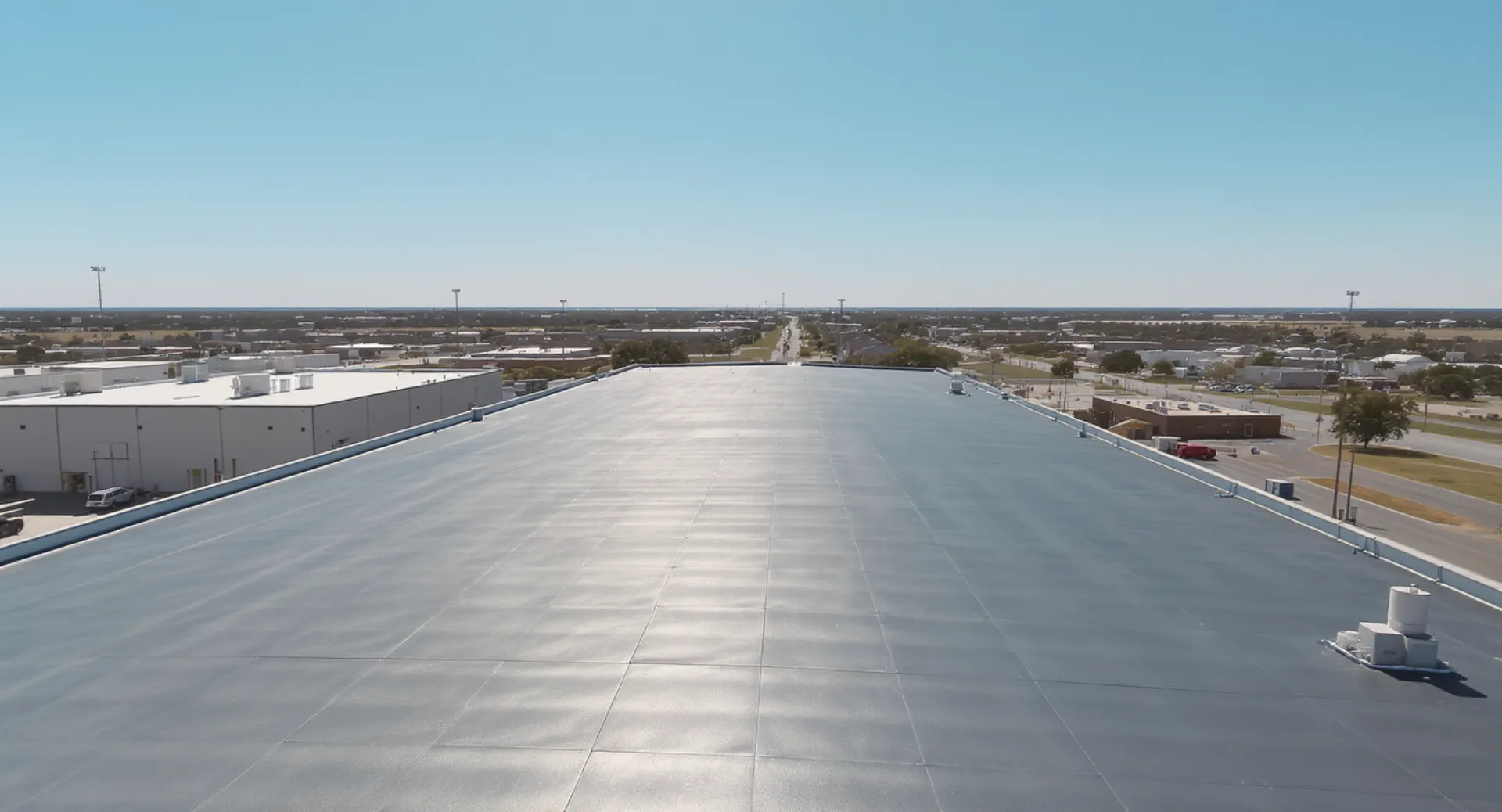
Heat-welded seams. Reflective white membrane. Engineered to meet FM 1-90 and FM 1-120 uplift requirements in ASCE 7 Exposure Category C terrain. Installed by Mule-Hide certified applicators.
- Max Membrane Thickness
- 80 mil
- FM Uplift Rating — Fully Adhered
- 120+ psf
- Estimated Service Life — 80 mil
- 30 yr
- Freeze-Thaw Cycles — Amarillo (NOAA)
- 10/yr
Why TPO Performs in the Texas Panhandle
TPO (Thermoplastic Polyolefin) is a polyester-reinforced single-ply membrane available in 45, 60, and 80-mil thicknesses. Its defining characteristic is the heat-welded seam — a hot-air weld that fuses both membrane edges into a molecular bond stronger than the surrounding membrane. In an environment with approximately 10 freeze-thaw cycles per year, daily temperature swings of 40–60°F, and annual extremes from below zero to above 110°F, the integrity of the seam system determines whether a roof performs for 20 years or 8. TPO's welded seams hold through that cycling in a way that tape-bonded EPDM seams historically have not.
The white membrane surface addresses Amarillo's specific UV challenge. At 3,607 feet, UV radiation is measurably higher than at sea level. White TPO reflects approximately 70–80% of solar radiation (CRRC-listed) and qualifies as a cool roof under Texas energy code. That reflectivity reduces membrane surface temperatures during Panhandle summers — where a dark surface can exceed 160°F — which directly extends membrane service life by slowing the polymer degradation that causes surface chalking and seam brittleness.
Wind uplift is where TPO's attachment method matters most. Amarillo's ASCE 7-16 design wind speed of approximately 110–125 mph, in Exposure Category C terrain (the open flat ground that characterizes the Panhandle), places commercial buildings among the highest inland wind load requirements in Texas. Fully adhered TPO bonded continuously to the substrate achieves FM 1-90 to FM 1-120+ uplift ratings in engineered assemblies — adequate for the perimeter and corner zones where uplift pressures are highest. Mechanically fastened systems can meet FM 1-90 field-area requirements but need increased fastener density at perimeter zones, and they introduce the flutter-fatigue risk that fully adhered systems eliminate.
For hail, the cover board selection largely determines the outcome. The May 28, 2013 storm that struck Amarillo with baseball-sized hail at approximately 2.75 inches in diameter generated $500 million in insured losses. An 80-mil TPO membrane over Mule-Hide Poly ISO 1-HD cover board (100 psi compressive strength) in a fully adhered assembly can qualify for FM VSH (Very Severe Hail) certification — the highest FM hail rating available. The HD cover board is the critical component: it absorbs impact energy and prevents the insulation beneath from compressing, which would cause long-term moisture infiltration even without an obvious membrane puncture.
System Specifications
- Membrane Thickness
- 45 / 60 / 80 mil
- Reinforcement
- Polyester Scrim
- Seam Method
- Hot-Air Welded
- Attachment Methods
- Fully Adhered / Mech. Fastened
- FM Wind Uplift
- 1-60 to 1-120+ psf
- FM Hail Rating
- MH to VSH (assembly)
- Solar Reflectance
- ~0.70–0.80 (white)
- Estimated Service Life
- 20–30 yr (mil-dependent)
- Warranty Availability
- NDL System (certified inst.)
FM ratings are assembly-dependent. Verify specific assembly listings for your project deck type and insulation configuration.
Building Types and Applications Where TPO Excels
TPO is the dominant commercial flat-roof specification in the United States, and for most standard commercial buildings in the Panhandle it is the correct choice. Distribution centers and warehouses — especially the large-footprint facilities along BNSF's Amarillo freight corridor — are prime TPO applications. The large, uninterrupted deck areas suit fully adhered or mechanically fastened installation, the white membrane meets energy code cool-roof requirements, and the system can be specified with FM 1-90 or FM 1-120 wind uplift assemblies appropriate for open-terrain exposure.
School buildings operated by AISD and Canyon ISD represent another strong TPO application. These buildings require long warranty horizons to align with bond-funded capital cycles, occupied-building installation protocols, and NDL warranty coverage that outlasts a typical 5-year maintenance budget. Mule-Hide-certified TPO installation qualifies for Premium NDL system warranties. For healthcare facilities — BSA Health System and Northwest Texas Healthcare combined represent thousands of square feet of roofing that tolerates zero water intrusion — fully adhered TPO with secondary flashing at all penetrations provides the leak-prevention reliability these environments demand.
TPO is the correct membrane where chemical resistance is not a primary concern. For buildings with restaurant exhaust, grease traps, or chemical processing vapors, PVC is the better choice — grease degrades TPO chemistry over time. TPO also underperforms where long-term ponding water is present; EPDM or silicone coating over an existing membrane handles sustained ponding better. For buildings with significant chemical or exhaust exposure, or for owners prioritizing a 40–60 year system life over 20–30, standing seam metal is the alternative worth evaluating.
TPO Installation: Assembly and Attachment
A TPO roofing assembly is a stack of components — deck, vapor retarder (where required), primary polyiso insulation, HD cover board, membrane, and edge metal — each of which affects the FM-rated wind uplift and hail resistance of the complete system. The membrane alone carries no FM rating; the assembly as a whole is what gets tested and rated.
The standard commercial assembly starts with the structural deck — typically 22- or 20-gauge fluted steel on commercial construction. Over the deck, polyiso insulation in two staggered layers (to eliminate direct thermal bridging at joints) provides the required R-value for Texas energy code. Over the polyiso, a half-inch HD polyiso cover board (100 psi compressive strength) provides the rigid, flat, high-strength substrate needed for both adhesive bonding and hail impact resistance. The TPO membrane bonds to this cover board either with fully adhered two-component contact adhesive or Mule-Hide self-adhering TPO (factory-applied adhesive backing), then heat-welded at all seams with a 6-inch minimum overlap.
Perimeter edge metal is specified and installed before the membrane terminates at the edge. ANSI/SPRI ES-1 tested edge metal systems rated to the project's FM wind uplift requirements are required by IBC. For Panhandle buildings in Exposure Category C, FM 1-90 or FM 1-120 edge metal is the typical specification — this is one of the most frequently underspecified details in the region, and edge metal failure is the mechanism that initiates progressive roof loss in wind events. A roof can have a perfectly installed membrane and still fail as a system if the edge metal lets go first.
For re-roof projects, the re-cover path depends on infrared moisture survey and core-cut results. A dry existing system with one existing layer can accommodate a new TPO system over recover board. A wet or two-layer existing system requires full tearoff. We document all survey findings in writing before any specification recommendation.
Panhandle Performance Engineering: Wind, Hail, and UV
The FM 4470 uplift rating system expresses resistance as "Class 1-XX" where XX equals pounds per square foot of upward wind pressure the assembly withstands. FM 1-60 = 60 psf; FM 1-90 = 90 psf; FM 1-120 = 120 psf. For the Texas Panhandle at 110–125 mph design wind speed and Exposure Category C terrain, the typical requirement is FM 1-90 minimum in the roof field and FM 1-120 at perimeter and corner zones (zones 2 and 3 in IBC/ASCE 7 terminology), where wind pressure coefficients are highest. A single FM rating for the entire roof is not sufficient — perimeter fastener density must be increased to match the higher zone requirements.
Hail rating in the FM system uses sub-freezing ice-ball tests — FM 4473 tests at 0°F to 20°F to replicate actual hailstone hardness at impact. This is the more rigorous standard versus UL 2218, which uses steel balls at room temperature. FM SH (Severe Hail) tests with 2-inch ice balls; FM VSH (Very Severe Hail) tests with larger balls under repeated impact in the same 6-inch zone. For Panhandle buildings in the Hail Alley corridor, engineering to FM SH at minimum and FM VSH where budget permits is defensible. Texas Department of Insurance allows 20–35% premium reductions for Class 4 impact-resistant systems under TDI requirements — a financial benefit worth documenting at installation with the required TDI form and manufacturer certification.
Thermal cycling is the third Panhandle-specific engineering consideration. The annual temperature range from below zero to above 110°F means a 100-foot TPO panel experiences substantial linear movement across the full year. Fully adhered systems accommodate this through continuous bond rather than discrete fastener points — the membrane moves with the substrate rather than cycling between fastener locations. At seams specifically, the hot-air weld's molecular fusion prevents the micro-separation that occurs in thermoplastic membranes at incompletely welded seam edges when temperature differentials impose shear stress. Proper weld verification — probe testing every seam after welding — is the installation quality check that separates 25-year roofs from 10-year roofs in this environment.
Manufacturer Certification
Mule-Hide Certified TPO Installer
Centennial Shield is Mule-Hide certified for TPO installation. That certification is required to offer Mule-Hide's Premium NDL system warranty — the coverage tier where Mule-Hide backs the full repair or replacement cost with no amortization for the warranty period. NDL coverage applies to the complete system: membrane, insulation, fasteners, adhesives, and flashings — all must be Mule-Hide-supplied or Mule-Hide-approved. A contractor purchasing Mule-Hide materials without certification cannot offer this warranty to their customer. The practical difference for a building owner: a certified installation has a second financial backstop if the installation fails; a non-certified installation does not.
Warranty applications are submitted to Mule-Hide at project completion. Coverage requires documented semi-annual inspections — we provide written inspection reports that satisfy manufacturer maintenance requirements and protect warranty validity. For federal and government projects, manufacturer certification also satisfies procurement quality requirements that increasingly specify certified-contractor installation for membrane systems.
- Certification Status
- Mule-Hide Certified
- Warranty Tier Access
- Premium NDL
- Coverage Scope
- System-Wide
- Min. Warranty Term
- Verify with Mule-Hide
- Maintenance Required
- Semi-Annual Inspection
- Warranty Application
- At Project Completion
TPO Roofing Questions — Amarillo and the Panhandle
- For most Panhandle commercial applications, 60-mil is the minimum meaningful specification — it provides the FM SH (Severe Hail) capability in engineered assemblies and qualifies for Mule-Hide NDL warranty tiers. 80-mil fully adhered over HD polyiso cover board is the maximum hail-resistance configuration available in single-ply membranes and achieves FM VSH (Very Severe Hail) ratings in certified assemblies. 45-mil is an entry-level product with shorter design life (approximately 15–20 years) that is better suited to low-exposure locations — not the Panhandle's open terrain and frequent severe weather.
- Mechanically fastened TPO creates a fastener-and-plate grid pattern that allows the membrane to flutter between attachment points under sustained high-wind and thermal cycling conditions. Amarillo's 13.6 mph annual average wind speed with frequent 70+ mph gust events makes this fluttering a long-term fatigue issue at seams. Fully adhered TPO bonds the membrane to the substrate continuously, eliminating flutter and achieving higher FM wind uplift ratings — FM 1-90 to FM 1-120+ versus FM 1-60 to FM 1-90 for mechanically fastened. It also eliminates the pattern of stress concentration at fastener locations that contributes to seam failure over time.
- TPO's thermoplastic construction is stiffer than EPDM rubber, which means it is more vulnerable to puncture from large hail impacts — but cover board selection largely determines the outcome. 80-mil TPO fully adhered over Mule-Hide Poly ISO 1-HD cover board (100 psi compressive strength) is the strongest single-ply hail-resistance configuration and can qualify for FM VSH ratings in certified assemblies. The HD cover board absorbs impact energy and prevents the insulation below from compressing under hailstone impact, which is the failure mode that causes post-hail moisture infiltration even when the membrane surface appears intact.
- TPO seams are made with a hot-air welder (robotic or hand) that heats both membrane edges and fuses them together — the resulting weld is chemically identical to the membrane itself and, when properly executed, is stronger than the surrounding membrane. EPDM seams use lap tape (uncured EPDM tape or pre-applied factory tape) pressed between membrane edges. The tape seam quality depends on surface prep, primer, and tape compression. Historically, seams are the number one failure point in EPDM systems, and tape seams do not achieve the molecular fusion that heat welding provides. For Panhandle conditions — wide temperature swings, frequent thermal cycling — heat-welded seams hold up significantly better over the membrane's service life.
- Standard Mule-Hide TPO is white in the field membrane — the white surface provides solar reflectance of approximately 0.70–0.80 and qualifies as a cool roof under ASHRAE, IECC, Texas energy code, and CRRC listings. This reflectivity matters at Amarillo's 3,607-foot elevation where UV index is meaningfully higher than at sea level. Mule-Hide's TPO Colorway line offers tan and gray field colors for aesthetic applications, but non-white membranes absorb more heat and reduce cool-roof energy performance. For most commercial applications in Amarillo, white is the correct specification — the energy code benefit and reduced membrane surface temperatures both extend service life.
- The Mule-Hide Premium NDL (No Dollar Limit) system warranty covers the membrane, insulation, fasteners, adhesives, and flashings — all must be Mule-Hide-supplied or Mule-Hide-approved in writing. NDL means no amortization: if a covered defect occurs in year 18 of a 20-year warranty, Mule-Hide pays the full repair cost, not a depreciated fraction. Installation must be by a Mule-Hide certified contractor (Warranty Eligible Contractor). Most NDL warranties require documented semi-annual inspections — missing that maintenance documentation can void a warranty claim. The specific year tiers and coverage terms should be confirmed with current Mule-Hide documentation at warranty application time.
- Potentially, but it depends on layer count and substrate condition. IBC and Texas building code limit structures to two roofing layers. If one layer already exists and the insulation tests dry (typically confirmed by infrared moisture survey and core cuts), a TPO recover system may be permissible. If the existing insulation is saturated, recover is not appropriate — wet insulation loses R-value, adds weight, harbors mold, and compromises adhesion of any new system. We perform infrared surveys and core cuts to determine the correct path before recommending recover versus tearoff.
- ANSI/SPRI ES-1 is the IBC-required standard for perimeter edge metal (drip edge, copings, fascia) wind uplift performance. Wind uplift at the roof perimeter is the highest load point on any roof, and edge metal failure initiates progressive roof loss — the membrane peels back from the edge inward. ES-1 tests (RE-1, RE-2, RE-3) rate edge metal systems to specific psf values. For the Panhandle's design wind speeds and Exposure Category C terrain, ES-1 edge metal at FM 1-90 or FM 1-120 equivalent is the correct specification — a detail that is frequently underspecified by contractors less familiar with high-wind zone requirements.
What mil TPO should I specify for a commercial building in Amarillo?
Why is fully adhered TPO better than mechanically fastened in Amarillo?
How does TPO perform under Amarillo's hail exposure?
How do heat-welded TPO seams differ from EPDM tape seams?
Is white TPO required, or are other colors available?
What does the Mule-Hide TPO NDL warranty actually cover?
Can TPO be installed over an existing single-ply or modified bitumen roof?
What edge metal standard applies to TPO installations in the Panhandle?
Related Roofing Systems and Services
Compare all six roofing systems
EPDM RoofingRubber membrane for freeze-thaw flexibility
PVC RoofingChemical-resistant single-ply membrane
Commercial Roof ReplacementFull tearoff and new system installation
Commercial Roof RepairLeak diagnosis and storm damage response
Government ContractsSDVOSB set-aside eligible — federal and state
Work With Us
Put a certified SDVOSB roofing contractor on your bid list.
SDVOSB and Mule-Hide certified — ready for government, industrial, and commercial projects across the Texas Panhandle.
SDVOSB set-aside eligible — Government contracting capabilities →