
Commercial Roof Replacement
Replace the Roof — With the Right Evidence First
Amarillo commercial buildings face a 120-degree annual temperature swing, 70+ mph wind events, and a documented history of baseball-sized hail. When replacement is the answer, it should be specified to current code — not the standard that was acceptable twenty years ago.
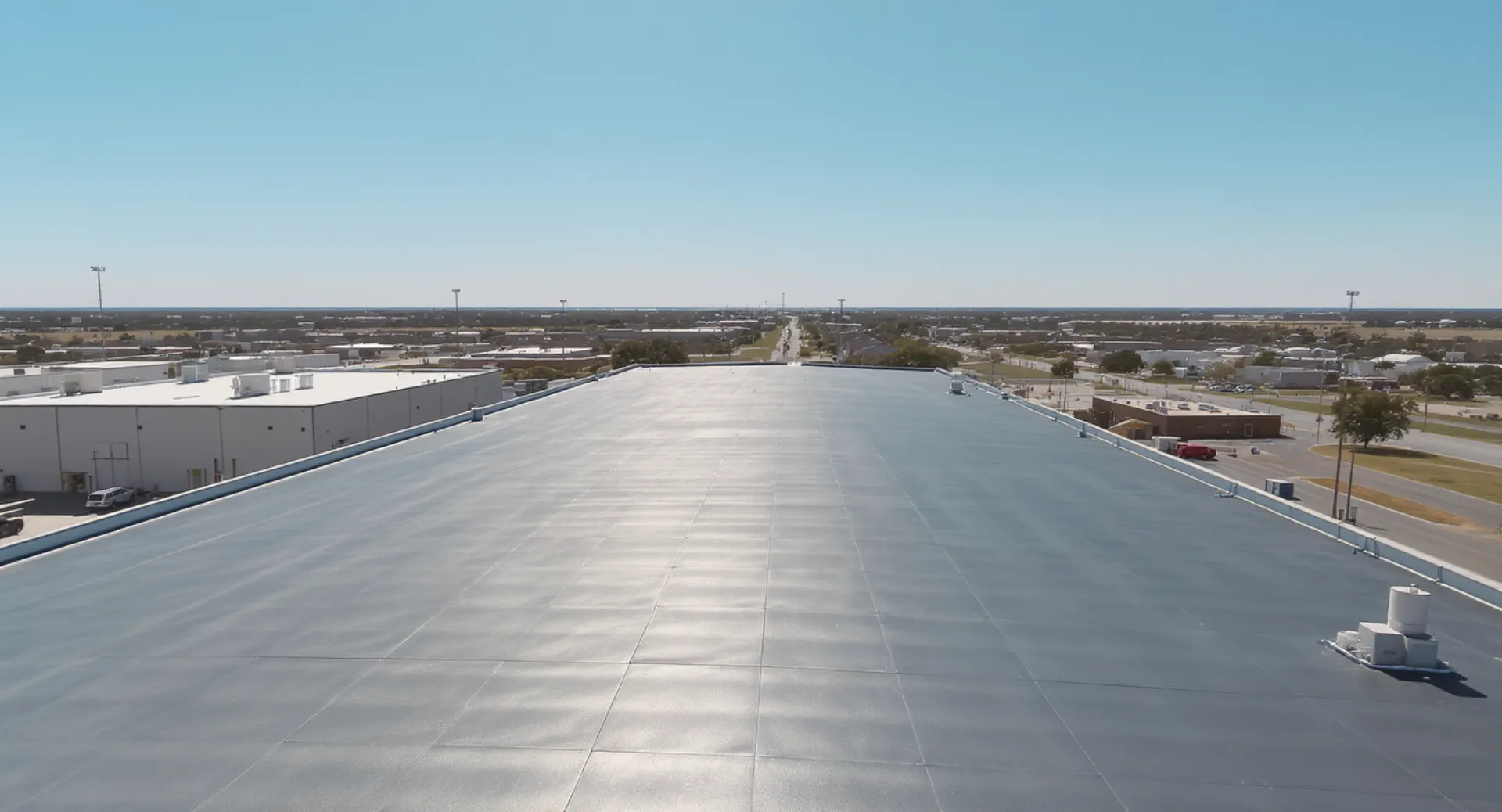
The Replace-or-Recover Decision
The first question in any commercial roof replacement project is not which membrane to use — it is whether the existing assembly must come off entirely or whether a recover system is code-permissible and technically sound. Getting this wrong in either direction is expensive. Recovering over wet insulation creates a warranty-voiding, energy-wasting time bomb. Specifying tear-off when recover was viable wastes disposal costs and landfill fees.
Most jurisdictions following IBC — including Amarillo and surrounding Panhandle municipalities — cap roofing assemblies at two total layers. If your building already has two roofing layers from prior repairs or an earlier recover, tear-off is required before any new system goes on. That is not a contractor preference; it is a code requirement that affects the permit and the warranty.
The second variable is insulation moisture content. An infrared survey conducted after a rain event — when thermal differential between wet and dry areas is greatest — gives a non-destructive read on the extent of saturation. We follow every survey with physical core cuts in flagged zones to confirm depth and condition. If more than roughly 25% of the insulation surface is saturated, recovering over it is not a sound investment: wet insulation loses R-value, harbors microbial growth, and provides poor adhesion for the new membrane. Full tear-off becomes the economically correct choice even when it was not technically mandatory.
The third variable is deck condition. Corroded steel deck flanges, deteriorated wood decking, or spalled concrete substrate must be addressed before any new system is installed. A replacement membrane bonded to a compromised deck may look correct on the day of installation and fail within years. We document deck findings in writing with photographs before any membrane work begins, and we do not proceed until the deck substrate is confirmed sound.
- Layer Limit (IBC)
- 2 layers max
- Recover Threshold
- ≤25% wet insulation
- Survey Method
- ASTM C1153 Infrared
- Core Cut Confirmation
- 3–5 cuts per survey
- Deck Inspection
- Required before membrane
- FM Uplift Field
- FM 1-90 minimum
- FM Uplift Perimeter
- FM 1-120 Exp. C
- Hail Rating Target
- FM SH or VSH
- Wind Design Speed
- 110–125 mph ASCE 7
- Wet insulation threshold for tear-off decision
- 25%
- FM wind uplift at perimeters (Panhandle standard)
- 120 psf
- Annual freeze-thaw cycles in Amarillo
- 10
- Insured losses from May 2013 Amarillo hailstorm
- 500M
What the Spec Should Actually Include
Commercial roof replacement in the Texas Panhandle is not simply swapping one membrane for another. The replacement event is the opportunity to correct every deficiency in the prior assembly — inadequate insulation R-value, undersized edge metal, missing cover board, and outdated fastener patterns that no longer meet current wind uplift requirements. A replacement spec that carries forward those same deficiencies is a missed opportunity and, in some cases, a code violation.
A properly written replacement specification for an Amarillo commercial building addresses insulation assembly first. Current energy codes require meaningful R-values; the standard two-layer staggered-joint polyiso installation achieves this while also eliminating thermal bridging at insulation joints that was common in single-layer assemblies. A high-density cover board — typically half-inch 100 psi polyiso or gypsum board — sits above the primary insulation to protect it from hail impact and provide the firm, continuous substrate required for fully adhered membrane application.
Edge metal is a frequent failure point in Panhandle storms. ANSI/SPRI ES-1 governs the wind uplift performance of perimeter edge metal, copings, and fascia — and that standard is required by IBC. A replacement that installs a new membrane over aged, undersized edge metal has not solved the most common Panhandle storm-failure mechanism. Every replacement we perform specifies new ES-1 tested edge metal matched to the building's wind exposure category.
Penetration flashings at HVAC curbs, pipes, and conduits account for a disproportionate share of leak callbacks on new installations. We specify and install membrane-compatible flashings at every penetration — not generic uncured EPDM or contractor-grade tape over incompatible substrates. If equipment curbs need raising to provide adequate flash height, that scope is identified before membrane work begins.
The membrane selection — TPO, EPDM, or PVC — is discussed in detail in our commercial roofing systems guide. For replacement specifically, the primary considerations are: building use (chemical or grease exposure argues for PVC), wind and hail exposure (fully adhered 80-mil TPO or PVC for maximum uplift and impact ratings), and the existing warranty situation.
Replacement as a Wind Uplift Upgrade
Amarillo holds the distinction of being the second-windiest city in the United States by annual average wind speed. Sustained wind events regularly exceed 70 mph, and the open terrain classification — ASCE 7 Exposure Category C — means commercial buildings here face wind pressure coefficients that are higher than the same building would experience in Lubbock or Abilene, which have more obstruction.
Many commercial buildings in Amarillo were roofed under an earlier code cycle with mechanically attached single-ply assemblies rated to FM 1-60. That rating corresponds to 60 pounds per square foot of wind uplift resistance in the field area. Current practice for the Panhandle specifies FM 1-90 minimum at the field and FM 1-120 at perimeters and corners — where uplift pressure from a high-wind event is three to four times the field pressure. The difference is not marginal: buildings with FM 1-60 assemblies have experienced partial roof loss in severe Panhandle wind events.
A replacement to a fully adhered membrane system resolves this. Fully adhered TPO assemblies over HD cover board can achieve FM 1-120 across the entire field, not just at perimeter zones. Coupled with ES-1 tested edge metal and properly detailed parapet terminations, the replacement assembly materially reduces storm loss exposure. For building owners who carry FM Global commercial property insurance, upgrading to FM-rated assemblies is often not optional — it is a policy compliance requirement.
Texas Department of Insurance mandates that carriers offer premium discounts for Class 4 impact-resistant roofing. The documentation package from our installations — FM assembly designation, Mule-Hide certification, and TDI Form PC068 support — gives your insurance carrier what they need to apply the discount, which runs 20–35% for Class 4-rated assemblies in the Panhandle. For a large commercial building, that annual savings compounds over the life of the new roof.
How We Execute a Replacement
The pre-construction sequence matters as much as the installation itself. Before any bid is finalized, we conduct the infrared survey, perform core cuts, and deliver a written assessment that identifies layer count, insulation condition, deck substrate findings, and drain layout. That document drives the spec — not a generic scope pulled from a prior job file.
Tear-off is staged in sections sized to expose only what can be re-covered in a single day. Panhandle weather requires this discipline — an exposed deck left open overnight is a water intrusion risk regardless of the forecast. We use temporary water barriers on any section not yet under new membrane by end of day. Tear-off debris is contained and hauled per municipal disposal requirements.
New insulation goes down in two layers with joints staggered in both directions — a code-required practice that eliminates the thermal bridging that single-layer installations create at every board joint. The cover board follows. Membrane installation proceeds according to the manufacturer's approved installation guide, and seam welds (for TPO or PVC) are tested with a probe after they cool. Every seam is documented in a written installation log.
At completion, the project file you receive includes: the executed Mule-Hide warranty document, the pre-construction infrared and core-cut report, as-built flashing details for every penetration, deck condition photos taken during tear-off, and the FM assembly specification. That documentation package follows the building — it is relevant to any future insurance claim, warranty claim, or sale of the property. Learn more about our ongoing maintenance programs that keep a new roof under warranty from day one. For new construction projects, see our new construction roofing coordination approach. Government and institutional buildings can review our SDVOSB contracting capabilities.
Roof Replacement — Questions We Get Often
- The decision comes down to three things: layer count, moisture content, and deck condition. IBC limits most buildings to two roofing layers total — if yours already has two, tear-off is mandatory before a new system goes on. We conduct an infrared moisture survey (ASTM C1153) after a rain event to identify wet insulation, then take physical core cuts to confirm findings. If less than 25% of the insulation is saturated and only one layer is present, recover is technically permissible. If the deck shows corrosion, rot, or delamination — regardless of layer count — tear-off and deck repair come first.
- Wet insulation retains heat from the sun longer than dry insulation. At dusk, an infrared camera captures that thermal differential as warm zones — areas where moisture is trapped in the assembly. The survey is non-destructive and covers the entire roof in a single pass, which is far more economical than coring every suspect area blind. We follow it up with core cuts in flagged zones to confirm what we found and determine how deep the saturation runs. While not legally required, skipping the survey on any roof over 10,000 square feet is specifying blind — you may pay to recover over saturated insulation that will continue degrading under your new membrane.
- A complete replacement scope includes: full tear-off of existing membrane and insulation to the deck, deck inspection and repair as needed, a fresh insulation assembly (typically two-layer staggered polyiso for current energy code compliance), cover board, new single-ply membrane (TPO, EPDM, or PVC depending on the building's exposure and use), ANSI/SPRI ES-1 edge metal upgrades, all penetration flashings, and drain inspection and resizing if needed. We document every layer removed and provide a written replacement report. The new assembly is specified to FM 1-90 minimum uplift at the field and FM 1-120 at perimeters — required under ASCE 7 Exposure C conditions here.
- Yes — and in the Texas Panhandle, this is one of the strongest financial arguments for replacement over patchwork repair. Amarillo sits in Exposure Category C terrain with design wind speeds of 110–125 mph. An older mechanically attached TPO assembly that originally met FM 1-60 likely does not meet current code minimums for this zone. A replacement with fully adhered 80-mil TPO or PVC over HD polyiso cover board can reach FM 1-120 and FM VSH (very severe hail) ratings. Texas Department of Insurance requires carriers to offer premium discounts for Class 4 impact-resistant assemblies — the documentation package we provide at project close supports that filing.
- A 20,000–40,000 square foot single-story commercial building typically takes 5–10 working days for a full tear-off and replacement, weather permitting. Panhandle spring weather is the primary variable — we schedule work around forecast windows and stage tear-off in sections so the deck is never exposed overnight without a temporary water barrier. Industrial buildings with complex penetration arrays, occupied facilities requiring phased work, and buildings with deck repairs add time. We provide a day-by-day schedule at contract execution.
- For most Amarillo-area commercial buildings — retail, office, warehouse, school, healthcare — 60 or 80-mil TPO fully adhered is the recommended specification. It combines reflective cool-roof performance, heat-welded seams that handle Panhandle thermal cycling, and FM VSH hail ratings in the right assembly. For buildings with kitchen exhaust, chemical exposure, or food processing operations, PVC is the correct choice — its chemical resistance is materially superior to TPO in those environments. EPDM is appropriate where long-term freeze-thaw performance and minimal maintenance are the priorities. We discuss each system's tradeoffs in writing before any contract is signed. See our detailed system pages for TPO, EPDM, and PVC.
- No — a full tear-off terminates the existing manufacturer warranty, because the warranted assembly no longer exists. The replacement project begins a new warranty clock. With Mule-Hide Premium NDL (No Dollar Limit) system warranties, the new warranty covers material, labor, and accessories with no amortization for the full warranty term — typically 15 or 20 years depending on the system specified. NDL warranty requires installation by a Mule-Hide certified contractor, which Centennial Shield is for TPO, EPDM, and PVC systems.
- At project completion you receive: a signed warranty application to Mule-Hide, the executed manufacturer system warranty document, the infrared survey report and core-cut photos from pre-construction assessment, a photo log of deck condition found during tear-off, as-built penetration flashing details, and the FM assembly designation for your new system. This package supports insurance premium filing with your carrier and satisfies most commercial lease requirements for roof documentation.
How do you decide between tear-off and recover on an existing commercial roof?
What does an infrared moisture survey actually show, and is it required?
What is included in a typical commercial roof replacement scope in Amarillo?
Can a roof replacement upgrade my wind uplift and hail resistance ratings?
How long does a commercial roof replacement take for a typical Amarillo building?
What membrane system is best for my commercial building type?
Does my existing warranty survive a roof replacement?
What documentation do I receive after replacement?
Replacement Assessment
Get the infrared survey before you budget for replacement.
We document what you actually have — layer count, moisture content, deck condition — so the replacement spec is built on evidence, not assumptions.
SDVOSB set-aside eligible — Government contracting capabilities →