Commercial Roofing Systems
Commercial Metal Roofing
Standing seam metal roofing with expansion clip systems engineered for the Panhandle's 120°F annual temperature swing, 110+ mph design wind speeds, and hail seasons that test every assembly specification.
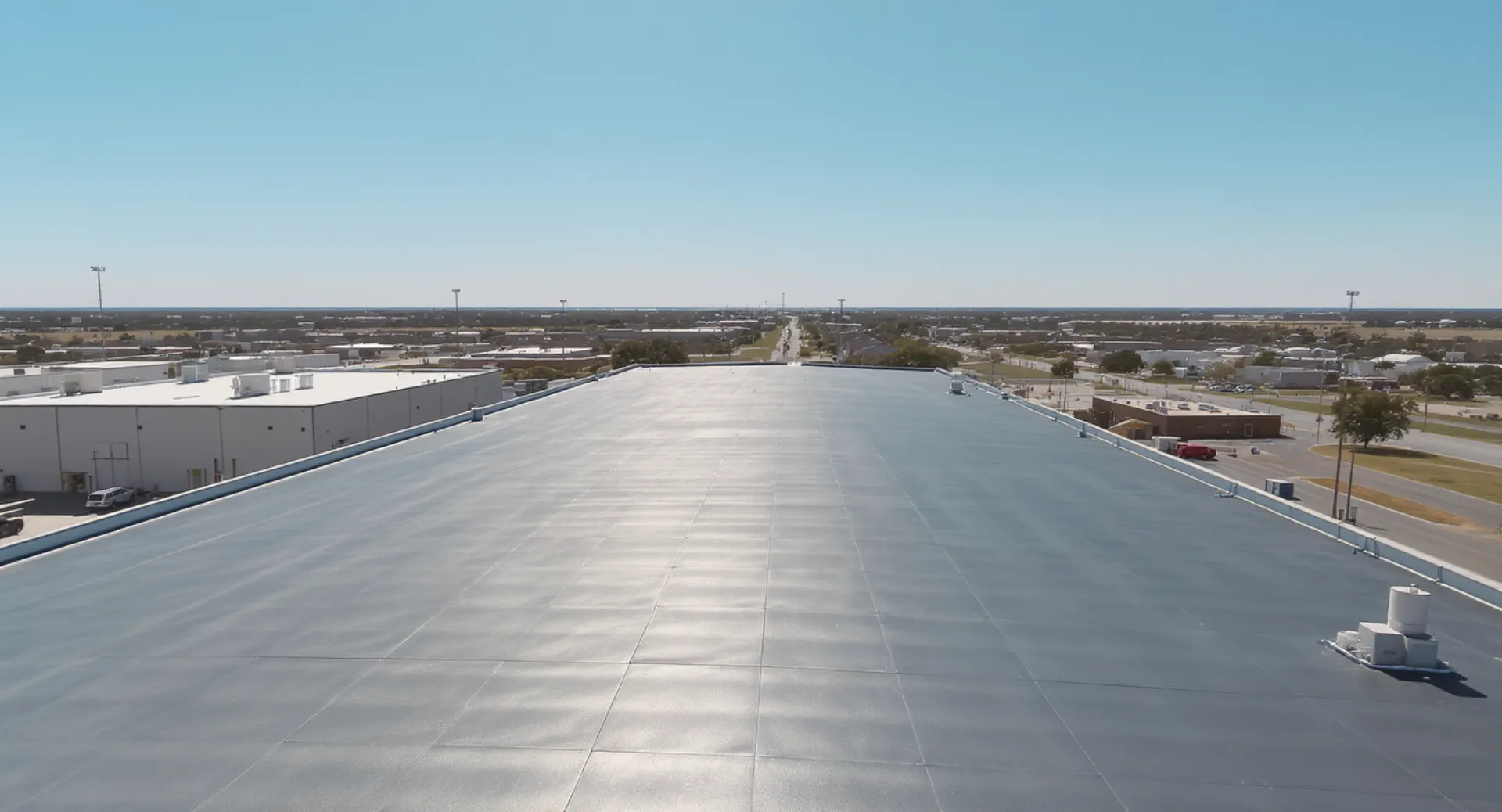
Standing Seam Metal — The Long-Game Specification
Commercial standing seam metal roofing is built around one structural principle: concealed attachment. Panels lock together at raised vertical seams — 1.5 to 3 inches tall — that keep all fasteners and clip hardware above the plane of water flow and below the seam cap. There are no screw penetrations through the panel field, which is the primary failure mechanism in agricultural corrugated metal and the reason that product is not appropriate for commercial buildings that expect 40-plus years of service.
Panel material is Galvalume steel — a hot-dip aluminum-zinc alloy coating bonded to steel substrate. Galvalume provides corrosion resistance at cut edges and dent sites without the rust propagation that paint-only coated steel shows when the factory finish is breached. For the Texas Panhandle, where a 2-inch hailstone hitting a steel panel at terminal velocity is a design-frequency event rather than a worst-case scenario, that corrosion resistance at impact sites matters over a 40-year service horizon.
Standard commercial gauge is 22–24 gauge steel. For Panhandle applications — with ASCE 7 Exposure Category C (open terrain, High Plains) and design wind speeds of approximately 110–125 mph for Risk Category II commercial structures — 22-gauge is the appropriate specification. The additional mass provides higher clip pullout resistance and meaningfully better dent resistance in hail impact. Aluminum panels (0.040–0.063 in.) are available and achieve UL Class 4 hail ratings, but aluminum dents more visibly than Galvalume steel under large hail and does not offer the same structural rigidity for wide-span commercial applications.
Factory finish is PVDF (polyvinylidene fluoride, trade name Kynar). At 3,607 feet of elevation — where Amarillo's atmosphere filters measurably less UV than coastal Texas — PVDF is the correct specification. Major coil coaters carry 30–40 year finish warranties on PVDF formulations. Polyester coatings, common on lower-cost metal products, chalk and fade far sooner under the UV load at this elevation.
- Panel Material
- 22–24 ga Galvalume steel | 0.040–0.063-in aluminum
- Seam Profile
- Snap-lock or mechanical seam — 1.5–3 in. height
- Attachment
- Floating (expansion) clips — concealed fasteners
- FM Wind Uplift Range
- 1-90 to 1-120+ psf
- Hail Rating
- UL 2218 Class 4 | FM SH achievable
- Factory Finish
- PVDF (Kynar) — 30–40 yr coil coater warranty
- Typical Service Life
- 40–60 years
- Testing Standard
- FM 4471 (Class 1 Panel Roofs)
- Thermal Movement
- Expansion clips required — up to ~0.84 in / 100 ft
- Year functional lifespan — Galvalume standing seam
- 40–60
- Annual temperature swing — Amarillo design range
- 120°F
- MPH ASCE 7 design wind speed, Panhandle Risk Cat. II
- 110+
Where Metal Wins the Lifecycle Calculation
Metal's case is a lifecycle cost argument, not a first-cost argument. A standing seam commercial metal roof costs more at installation than a TPO or modified bitumen system. That gap closes over time because metal systems routinely operate 40–60 years with limited maintenance, while most membrane systems reach end-of-life in 20–30 years and require full replacement. A building owner who installs a quality metal roof on a new commercial structure may never replace that roof in the life of the building.
Agricultural and industrial facilities across the High Plains are the natural fit for standing seam commercial metal. Wide-span construction — equipment storage, implement buildings, processing facilities, distribution warehouses — aligns with metal's structural span capability and tolerance for the equipment access and foot traffic that these facilities generate. The Panhandle's active cattle feeding, grain, and energy sectors all have significant flat-roof and low-slope building inventories where metal's long service life and low maintenance demands justify the upfront investment.
New construction commercial projects — retail, office, institutional — where the owner or developer intends a long hold period are the other primary metal application. The 40–60 year service life aligns with the depreciation horizon of commercial real estate and eliminates the re-roofing disruption and cost that a membrane system produces at the 25-year mark.
Metal also creates a practical synergy with roof coatings. On existing metal buildings where hail has caused micro-cracking in the factory finish or where a dark metal surface is generating substantial cooling loads, silicone or aliphatic urethane coatings applied directly to the metal can seal the surface, restore reflectivity, and extend service life by 10–20 years at a fraction of full replacement cost. That route makes economic sense when the metal substrate itself is structurally sound but the finish is compromised.
Engineering for Panhandle Wind, Hail, and Thermal Movement
Three physics problems define metal roofing specification in Amarillo: thermal expansion, wind uplift, and hail impact. Each has a direct engineering answer — and the answers interact in ways that make proper system design more than a materials selection exercise.
Thermal expansion is the most commonly under-specified. Steel expands at approximately 0.000007 inches per inch per degree Fahrenheit. A 100-foot panel across Amarillo's full annual temperature range — roughly -10°F to 110°F, a 120°F swing — moves about 0.84 inches. Floating expansion clips accommodate this longitudinal movement while maintaining lateral restraint against wind uplift loads. Fixed clips, appropriate only for short panel runs where movement is negligible, will eventually fatigue their fastener connections under the repeated cycle of a Panhandle year. Buildings with fixed-clip metal roofs installed without thermal analysis are the ones that develop loose panels and wind-event failures.
Wind uplift is governed by FM 4471 for commercial metal panel systems — the metal equivalent of FM 4470 for single-ply membranes. The clip material gauge, clip height, fastener size and pattern, and the structural framing below all contribute to the rated assembly uplift. Properly engineered standing seam with appropriate clip systems achieves FM 1-90 to FM 1-120+ — meeting and exceeding the field and perimeter requirements that Amarillo's Exposure Category C terrain imposes. The perimeter edge condition (gutters, rake edges, fascia) must still meet ANSI/SPRI ES-1, the same standard that governs membrane system edge metal.
Hail impact on metal is a managed outcome, not an avoided one. The raised seam profile causes hailstones to strike at an oblique angle, reducing impact energy per unit area relative to flat-panel systems. A 22-gauge Galvalume panel achieves UL 2218 Class 4 — which typically earns the maximum Texas Department of Insurance premium credit of 20–35% for commercial properties in high-hail zones. Functional failure (leaks) from hail on properly specified standing seam is rare; cosmetic denting is the realistic outcome from the largest hail events. For comparison with membrane alternatives on hail-exposed buildings, see our pages on TPO roofing and modified bitumen systems.
Details That Govern Long-Term Performance
Commercial metal roofing performance over a 40-plus year service life depends less on the panel itself than on the details at penetrations, transitions, and the interface between the metal system and the building enclosure. These are the failure origin points on metal roofs, and they are well-understood problems with well-established solutions.
Penetration flashings — HVAC curbs, exhaust fans, pipe stacks — must accommodate the same thermal movement as the panel field. A rigid curb cap welded or caulked to a standing seam panel will develop a gap at one edge as the panel moves seasonally. The correct approach uses bellows-type or sliding flashing details that allow panel movement while maintaining water tightness. On buildings with significant rooftop equipment — common in industrial and institutional facilities — coordinating the flashing details for each penetration before panel installation begins is the difference between a watertight roof and a maintenance-intensive one.
Condensation control is a consideration on metal roofs in the Panhandle's climate range. The large temperature differential between a cold winter night and the warm interior of a heated building drives moisture toward the dew point on the metal panel underside. Insulation placed between the purlins or as continuous rigid board above the purlins, with thermal breaks at clip attachment points, manages this effectively. Poorly insulated or uninsulated metal roofs on conditioned spaces can develop chronic interior condensation that damages stored goods and building contents — a property management issue that is entirely avoidable with proper design.
For building owners evaluating whether commercial roof repair on an existing metal system or a full replacement is the right course, condition of the clip connections and perimeter edge metal are the governing factors. Panels that rattle or flex in wind indicate compromised clip engagement — a repair that requires re-engagement of the seam, not just surface coating. Rusted-through edge metal or gutters allow water entry at the perimeter that damages insulation and decking. An infrared survey can locate areas of wet insulation under metal roofing, informing whether targeted repair or full replacement is the correct path. Our government contracting capabilities include commercial metal roofing for federal and municipal facilities across the Panhandle under SDVOSB set-aside procurement.
Commercial Metal Roofing — Common Questions
- Standing seam metal roofing uses vertical raised seams — typically 1.5 to 3 inches tall — that elevate the panel joints above the plane of water flow. There are no exposed fasteners through the membrane field; all attachment is through concealed clips underneath the panels. Corrugated metal (exposed fasteners, overlapping flat panels) is a residential and agricultural product. Commercial standing seam — with mechanical seaming tools, engineered clip systems, and factory PVDF coatings — is a different product category with a 40–60 year functional lifespan and engineering documentation to support that claim.
- Steel expands and contracts with temperature. A 100-foot steel panel sees roughly 0.84 inches of total movement across a 120°F temperature swing — and Amarillo's annual temperature range runs from approximately -10°F to 110°F, which is exactly that 120°F span. Floating (expansion) clips allow the panel to slide longitudinally in its clip while maintaining lateral wind-uplift resistance. Without them, fixed-point attachment under repeated thermal cycling fatigues the connection over time, loosening the fastener engagement that holds the roof down in a 70+ mph wind event. This is not a theoretical concern on the High Plains — expansion clip specification is non-negotiable in this climate.
- Steel standing seam panels at 22–24 gauge Galvalume can achieve UL 2218 Class 4 — the highest impact-resistance rating, using a 2-inch steel ball dropped from 20 feet. FM SH (Severe Hail) and FM VSH (Very Severe Hail) ratings are achievable with properly specified metal assemblies. The raised seam profile is a physical advantage here: hailstones strike the angled seam face at an oblique angle rather than flat impact at 90 degrees, reducing the energy transferred to the panel field. Large hail will dent Galvalume steel panels — that denting is cosmetic, not a functional failure in well-specified systems, and Galvalume's aluminum-zinc alloy coating provides corrosion resistance at the dent site.
- 22-gauge is the stronger choice for Panhandle commercial and industrial applications. At 22 gauge, the panel has greater dent resistance under hail impact and higher clip pullout values for wind uplift — both relevant for this climate. 24-gauge is acceptable for lower-exposure or lower-slope applications, but given that Amarillo's High Plains terrain classifies as ASCE 7 Exposure Category C and design wind speeds reach approximately 110–125 mph for Risk Category II buildings, the additional material cost for 22-gauge is justified by the engineering margin it provides.
- Metal retrofit is a legitimate upgrade path for flat or low-slope commercial buildings. A structural subframing system (purlins or hat channel over the existing structure) is installed over the current roof, the standing seam panels go over that, and the existing membrane is encapsulated rather than torn off. This eliminates landfill disposal of the existing system and provides a new 40–60 year envelope. The structural subframing must be engineered to carry the added dead load and meet the same wind uplift requirements as a new-construction metal roof. Metal also pairs well with our roof coatings program — hail-aged metal with micro-cracks in the factory finish benefits from silicone or urethane coating before a full metal replacement becomes necessary.
- Amarillo sits at approximately 3,607 feet elevation — the highest-elevation major city in Texas. At that altitude, UV radiation intensity is measurably higher than at sea level, accelerating the degradation of lesser coil coatings. PVDF (polyvinylidene fluoride, sold under the trade name Kynar) is the commercial standard for roofing applications precisely because of its UV resistance: properly formulated PVDF coatings carry 30–40 year finish warranties from major coil coaters and resist the chalking and color shift that polyester-based coatings develop much earlier in their service life. For Panhandle commercial buildings, PVDF is not a premium option — it's the correct specification for a system intended to last 40–60 years.
- Metal roofs require less routine maintenance than membrane systems, but they are not maintenance-free. Twice-yearly inspection is recommended — spring and fall. Inspection focuses on: perimeter edge metal and coping cap condition; gutter attachment and condition; penetration flashings at HVAC curbs, conduits, and skylights; panel condition at seams for any oil-canning or seam deformation; and evidence of organic growth or debris accumulation in valleys. After hail events, prompt inspection and photo documentation matters for insurance purposes — surface denting from hail over 1.5 inches should be documented even when the roof is not actively leaking. Our commercial roof maintenance program covers metal roofs alongside membrane systems.
- Standing seam metal is the dominant system choice for agricultural and industrial buildings across the High Plains for good reasons: the long service life (40–60 years versus 20–30 for most membrane systems) reduces lifecycle replacement cost; the concealed fastener design eliminates the screw-through-metal leak paths common in agricultural metal panels; and the structural span capability of heavy-gauge panels suits wide-span buildings like distribution warehouses, equipment storage, and processing facilities. For facilities with chemical exhaust or processing environments, a consultation on coating compatibility is warranted — some industrial environments attack standard PVDF coatings.
What is standing seam metal roofing and how is it different from corrugated metal panels?
Why are expansion clips critical for metal roofing in the Texas Panhandle?
What FM and UL hail ratings does commercial standing seam metal achieve?
Is 22-gauge or 24-gauge steel the right specification for Amarillo commercial buildings?
Does a metal roof make sense for an existing building that has membrane roofing?
How does PVDF (Kynar) coating affect long-term performance at Amarillo's elevation?
What is the maintenance program for a standing seam metal commercial roof?
Is a metal roof appropriate for agricultural or industrial facilities in the Panhandle?
Work With Us
Put a certified SDVOSB roofing contractor on your bid list.
SDVOSB and Mule-Hide certified — ready for government, industrial, and commercial projects across the Texas Panhandle.
SDVOSB set-aside eligible — Government contracting capabilities →