Commercial Roofing — Amarillo, TX
Commercial Roofing Systems for the Texas Panhandle
Six membrane and metal systems. One contractor certified in three of them. Every specification engineered for Panhandle wind loads, hail exposure, and the temperature swings that separate West Texas from the rest of the state.
- Annual Avg Wind Speed — 2nd in U.S.
- 13.6 mph
- 2013 Hailstorm Insured Losses ($)
- 500M
- ASCE 7 Design Wind Speed (mph)
- 110+
- Amarillo Elevation — Highest Major TX City
- 3607 ft
Why Panhandle Roofing Is a Different Specification Problem
Amarillo sits at 3,607 feet — the highest-elevation major city in Texas — and records an annual average wind speed of 13.6 mph, making it the second-windiest city in the United States. ASCE 7-16 assigns this region Exposure Category C (open, flat terrain) with design wind speeds of approximately 110–125 mph for Risk Category II commercial buildings. Those numbers translate directly to FM 1-90 minimum uplift ratings for roof field areas and FM 1-120 at perimeters and corners. A membrane system that meets code in Houston or Austin will not meet the structural requirements here without upgraded fastener patterns, fully adhered attachment, and ANSI/SPRI ES-1 tested perimeter edge metal.
The hail exposure is equally specific. On May 28, 2013, baseball-sized hail struck Amarillo and generated $500 million in insured losses — the costliest weather event in the city's history. That storm was not a one-time outlier. NWS records show Doppler radar detecting hail at or near Amarillo on 192 occasions in a single recent 12-month period. The FM hail rating system uses sub-freezing ice-ball tests (FM 4473), not steel balls at room temperature, specifically because hailstones are hardest when they arrive — a distinction that matters when specifying membrane assemblies for this region.
Elevation adds a third variable most Texas roofing discussions skip entirely. At 3,607 feet, UV radiation is measurably higher than at sea level — a practical consequence for membrane chemistry, coating longevity, and the degradation rate of any polymer-based system. White TPO and PVC membranes reduce the heat absorption problem, but surface chalking and micro-cracking still accelerate at elevation compared to the same membrane in Dallas or San Antonio. Specifying 80-mil membrane instead of 45-mil is not upselling — it is compensating for an environment that shortens membrane life predictably.
NOAA Engineering Weather Data for Amarillo records approximately 10 freeze-thaw cycles per year — the number of times ambient temperature crosses 32°F. That is not unusual by northern-state standards, but it is exceptional for Texas, where most commercial roofers operate in climates that rarely freeze. Each thermal cycle stresses seams, flashings, and any adhesive bond between insulation layers. Fully adhered systems and hot-air welded seams outperform mechanically attached assemblies on this axis, which is why they are the preferred specification for long-term Panhandle installations.
System Selection by Building Type and Sector
Distribution & Warehousing
Large Flat Decks, High Wind Exposure
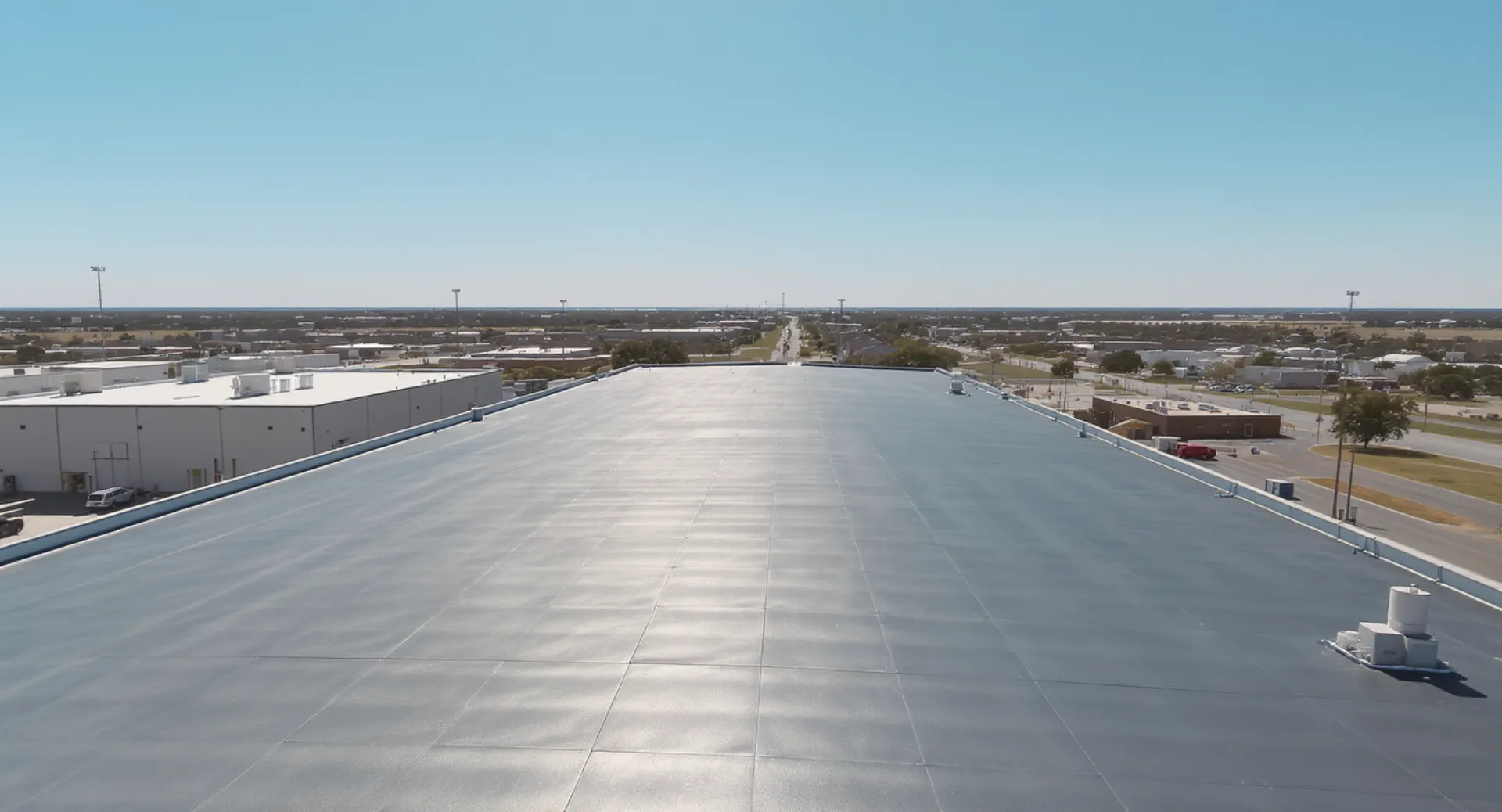
Distribution and warehousing buildings — the rail-served facilities along BNSF's Amarillo corridor, the logistics centers at Rick Husband Airport's development zone — are typically steel deck, large footprint, low slope. The deck gauge and open-exposure location drive the wind uplift spec. Fully adhered 60- or 80-mil TPO or PVC over HD polyiso cover board is the standard approach, with perimeter edge metal specified to ANSI/SPRI ES-1. Ballasted systems are not appropriate in this terrain.
Schools & Municipal Buildings
Bond-Cycle Projects, Long Warranty Horizons
AISD operates 55 school buildings representing approximately 5 million square feet of roofing. Canyon ISD adds 21 more. These buildings run on bond-funded capital cycles, are occupied during installation, and require NDL system warranties that outlast typical budget cycles. Mule-Hide-certified TPO or EPDM with premium NDL coverage is the typical specification. Our SDVOSB certification also positions us for government-adjacent procurement on publicly funded school projects.
Healthcare Facilities
Occupied Buildings, Zero-Leak Tolerance
BSA Health System and Northwest Texas Healthcare together employ more than 5,000 people across Amarillo. Healthcare roofing tolerates no water intrusion events — the operational and liability cost of a leak into a sterile environment is extreme. Fully adhered single-ply with secondary leak prevention at penetrations, documented inspection protocols, and NDL warranty coverage are the baseline requirements. EPDM's long lifespan and TPO's cool-roof reflectivity are both valid depending on facility age and structure.
Retail & Commercial Properties
I-40 Corridor and Westgate Buildout
TxDOT's $30 million Business I-40 improvement project and the $133 million SL 335 interchange are driving new commercial development along Amarillo's primary corridors. New-construction retail is steel deck, typically requiring a fully coordinated roof spec from design through membrane installation. Retail buildings with kitchen exhaust penetrations or grease-trap venting need PVC, not TPO — grease degrades TPO membranes over time. Retrofit on existing retail strip centers is often served well by silicone coating when the existing membrane is structurally sound.
Industrial & Processing Facilities
Chemical Resistance, Load Ratings
Tyson Fresh Meats, regional food processing operations, and the Borger energy corridor represent the industrial tier. PVC is the correct membrane for any facility with chemical exhaust, grease, or processing vapors — its chemical resistance is significantly stronger than TPO or EPDM. For large industrial spans with heavy HVAC loading, standing seam metal on structural steel purlins is a 40–60 year system that matches the building's design life. See our industrial roofing page for application-specific details.
Government & Federal Buildings
SDVOSB Set-Aside Eligible
The Thomas E. Creek VA Medical Center, J. Marvin Jones Federal Building, GSA-managed properties, and the federal contractor ecosystem surrounding Pantex represent a substantial government roofing market. Centennial Shield's SBA VetCert SDVOSB certification gives us a direct procurement lane for federal set-aside contracts. No other Panhandle-based commercial roofing contractor has a documented SDVOSB web presence. See our government contracting capabilities page for NAICS codes and procurement details.
Six-System Specification Comparison
All FM ratings are assembly-dependent — membrane, insulation, cover board, fastener pattern, and deck type each affect the rated performance. The ranges below reflect achievable ratings in engineered assemblies; actual project ratings depend on site-specific design.
| System | Thickness | FM Wind | FM Hail | Service Life | Chemical Res. | Panhandle Fit |
|---|---|---|---|---|---|---|
| TPO | 45/60/80 mil | 1-60 to 1-120+ | MH to VSH | 20–30 yr | Moderate | Excellent |
| EPDM | 45/60/90 mil | 1-60 to 1-90 | MH to VSH | 25–35 yr | Low | Good |
| PVC | 50/60/80 mil | 1-60 to 1-120+ | SH to VSH | 20–30 yr | Excellent | Excellent |
| Mod Bit | 2-ply | 1-60 to 1-90 | SH w/ cover board | 20–30 yr | Low | Good |
| Metal (SS) | 22–24 ga | 1-90 to 1-120+ | UL Class 4 / FM SH | 40–60 yr | High | Excellent |
| Coatings | 20–40 dry mil | Restoration | Restoration | +10–20 yr ext. | Varies | Very Good |
MH = Moderate Hail · SH = Severe Hail · VSH = Very Severe Hail · SS = Standing Seam
Explore Each Roofing System
Roofing System
TPO Roofing
View specs and Panhandle performance →
Roofing System
EPDM Roofing
View specs and Panhandle performance →
Roofing System
PVC Roofing
View specs and Panhandle performance →
Roofing System
Modified Bitumen Roofing
View specs and Panhandle performance →
Roofing System
Metal Roofing
View specs and Panhandle performance →
Roofing System
Roof Coatings
View specs and Panhandle performance →
From New Construction to Coating Restoration
System type is one decision; job type is another. A building owner may need a full tear-off and replacement, a targeted repair after storm damage, a re-cover over a single existing layer, or a coating restoration to extend life another decade. Each path has a different cost structure, code compliance requirement, and warranty outcome.
Manufacturer Certification
Mule-Hide Certified in TPO, EPDM, and PVC
Mule-Hide's certified contractor program requires manufacturer-approved training and documented installation standards. Certification is what unlocks Premium NDL (No Dollar Limit) system warranties — where Mule-Hide covers the full repair or replacement cost with no amortization for the life of the warranty period. A non-certified installer cannot offer NDL coverage, regardless of what materials they purchase. When you receive a warranty document from Centennial Shield, it is backed by the manufacturer, not just the contractor.
- TPO Certification
- Mule-Hide Certified
- EPDM Certification
- Mule-Hide Certified
- PVC Certification
- Mule-Hide Certified
- Warranty Type
- NDL Available
- Coverage
- System-Wide
- SDVOSB Status
- SBA VetCert
Commercial Roofing Questions for the Texas Panhandle
- There is no single answer — the right system depends on your building type, budget horizon, and specific exposures. For most commercial flat roofs in Amarillo, 60- or 80-mil TPO fully adhered is the workhorse spec: heat-welded seams handle thermal cycling, white membrane reduces cooling loads at 3,600 ft elevation, and it can be engineered to FM 1-90 or FM 1-120 wind uplift ratings required in ASCE 7 Exposure Category C terrain. EPDM rubber is the better choice where freeze-thaw flexibility is the primary concern. PVC is the correct call when grease or chemical exhaust is involved. Standing seam metal offers the longest service life (40–60 years) and is the strongest hail performer, but at a higher initial cost.
- FM (Factory Mutual) ratings express the wind uplift resistance of a complete roof assembly — membrane, insulation, fasteners, and deck — tested as a system, not just the membrane alone. An FM 1-90 assembly withstands 90 psf of upward pressure; FM 1-120 withstands 120 psf. The Texas Panhandle's ASCE 7-16 design wind speed runs approximately 110–125 mph for Risk Category II buildings in Exposure Category C terrain (open, flat ground). That translates to FM 1-90 minimum for roof field areas and FM 1-120 at perimeter and corners on most commercial buildings. If your building is FM Global insured, FM-approved assemblies are typically required by your policy — a detail worth confirming with your broker.
- Large hail — like the baseball-sized stones that struck Amarillo on May 28, 2013 — can cause membrane bruising and insulation compression that isn't visible from street level. TPO and PVC membranes may show surface dimpling without immediate leaks, but compromised insulation beneath the membrane loses R-value and eventually allows moisture migration. EPDM is more forgiving on impact due to its rubber elasticity, but aged EPDM becomes stiffer and more brittle at sub-freezing temps. After any significant hail event, infrared moisture scanning and physical core cuts are the reliable way to assess damage. We document all findings in writing — critical for insurance claims.
- Texas has no mandatory state roofing contractor license. Any person can legally perform commercial roofing in Texas without passing an exam, holding insurance, or demonstrating experience. The RCAT (Roofing Contractors Association of Texas) offers a voluntary commercial certification that requires two years of Texas roofing experience, $500,000 in liability coverage, and passing a commercial roofing exam — but it is not required by law. This means the market contains a wide range of operators after every major storm. For commercial facility managers and building owners, the meaningful credentials are manufacturer certification (which requires documented training and quality standards), general liability and workers' compensation insurance, and bonding capacity for the project size.
- SDVOSB stands for Service-Disabled Veteran-Owned Small Business. The SBA's VetCert program certifies businesses majority-owned and operated by service-disabled veterans, making them eligible for federal set-aside contracts and sole-source awards. Centennial Shield is SBA VetCert certified. For federal agencies — the VA, GSA, NNSA at Pantex, DoD installations — procurement officers are required to give priority consideration to SDVOSB bids. If you are a facility manager at a government building in the Panhandle, we can bid on set-aside awards. For private-sector clients, the certification simply confirms a thoroughly vetted ownership and management structure.
- The IBC (and Texas building code) limits structures to two roofing layers. If your building already has two layers, tearoff is required before any new installation. Beyond code, the practical threshold is roughly this: if damaged or saturated area is less than 25% of the total roof and the membrane has more than half its useful life remaining, targeted repair plus a verified dry field is the right path. If saturation or damage exceeds 25%, or the membrane is past its design life, replacement is the more economical long-term choice. We perform infrared moisture surveys and core cuts to give you actual data — not a guess based on a visual walk.
- Mule-Hide's certified contractor program requires manufacturer-approved training, demonstrated installation history, and compliance with quality standards. Certified status is what allows us to offer Mule-Hide Premium NDL (No Dollar Limit) system warranties — where Mule-Hide backs the full repair or replacement cost with no amortization, regardless of when in the warranty period a covered defect occurs. You can verify contractor certification status directly with Mule-Hide. The practical difference matters: a non-certified installer cannot offer NDL warranty coverage, even if they purchase Mule-Hide materials.
- Most Mule-Hide NDL system warranties require documented semi-annual inspections at minimum. The NRCA recommends spring (post-freeze-thaw season) and fall inspections as baseline. In the Panhandle, add an inspection within 5–10 business days after any hail event or 70+ mph wind event — photo documentation at that point is essential for insurance purposes. Inspections should cover all field seams, penetration flashings, perimeter edge metal, drain bodies, and any areas where rooftop equipment has been serviced. Written inspection reports with photos, filed per-building, are what satisfy most warranty maintenance requirements. Missing that documentation can void a warranty claim.
Which commercial roofing system is best for the Texas Panhandle climate?
What does FM-rated roofing mean, and do I need it in Amarillo?
How does hail damage affect a commercial membrane roof that looks fine from the ground?
Does Texas require commercial roofing contractors to be licensed?
What is SDVOSB and why does it matter for my roofing project?
When should I repair vs. replace a commercial roof?
How do I know if a roofing contractor is really Mule-Hide certified?
What maintenance does a commercial flat roof actually need to stay under warranty?
Work With Us
Put a certified SDVOSB roofing contractor on your bid list.
SDVOSB and Mule-Hide certified — ready for government, industrial, and commercial projects across the Texas Panhandle.
SDVOSB set-aside eligible — Government contracting capabilities →