SERVICE AREA · TEXAS PANHANDLE
Texas Panhandle Service Area
Amarillo-based commercial roofing contractor serving a 200-mile radius across the Texas Panhandle and South Plains. SDVOSB certified. Mule-Hide certified for TPO, EPDM, and PVC.
01 / The Market
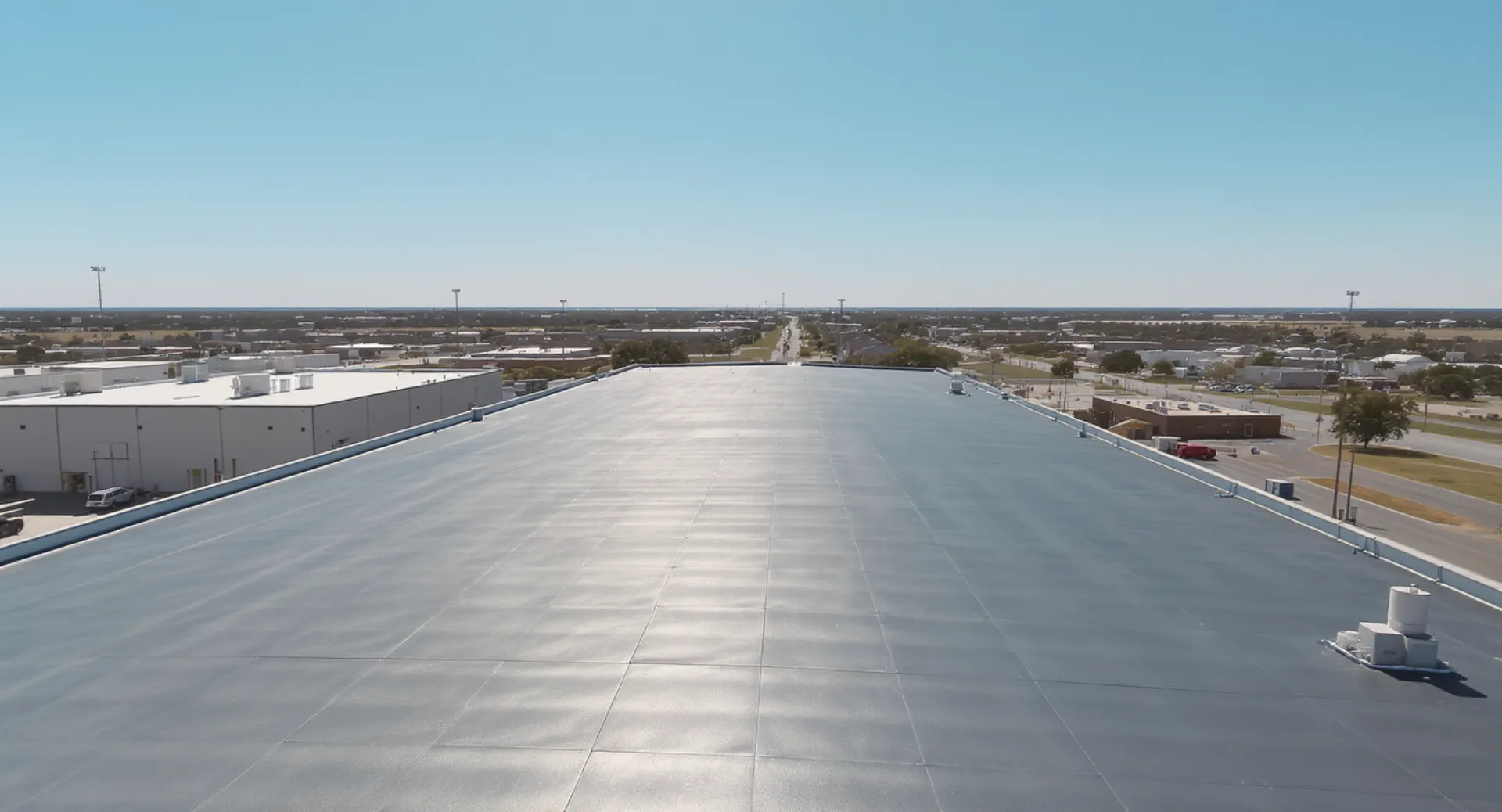
The Texas Panhandle roof market is unlike anywhere else in the state.
Three forces define commercial roofing on the High Plains: the wind, the hail, and the cold. Amarillo carries the second-highest annual average wind speed of any city in the United States — 13.6 mph, per NWS records — in terrain classified as ASCE 7 Exposure Category C, the open-terrain classification that produces the highest uplift coefficients for a given design speed. Design wind speeds for commercial structures in this zone run approximately 110–125 mph under the current IBC adoption. Perimeter edge metal, termination bars, and fastener patterns that pass muster in Dallas fail here.
The hail record is just as clear. On May 28, 2013, a single storm dropped baseball-sized hail across Amarillo, produced $500 million in insured losses, and damaged approximately 75 percent of residential property in the city. NWS Doppler data documents 24 confirmed hail reports within 10 miles of downtown Amarillo in a single recent year alone. Roofing specifications that are adequate for central Texas are not adequate here — Class 4 UL 2218-rated membranes are the floor, not a premium option.
Add roughly ten freeze-thaw cycles per year at 3,600 feet of elevation — more than any other major Texas market — and the result is a climate that separates properly specified roofing systems from those that merely look correct on a submittal sheet. CSGC designs and installs to the Panhandle's actual environmental load, not a specification written for the Gulf Coast.
- Avg annual wind — 2nd in US
- 13.6 mph
- Freeze-thaw cycles per year
- 10
- Annual temp swing (−10 to 110)
- 120°F
- Elevation above sea level
- 3600 ft
02 / Amarillo Base
Amarillo — headquarters and largest market.
Centennial Shield is based in Amarillo and the Amarillo metro is our primary market. The commercial and industrial building stock here represents the densest concentration of flat and low-slope roofing in the region — and the most demanding specification environment in the state.
The Pantex Plant in Carson County — the United States' primary nuclear weapons assembly and disassembly facility — operates approximately 650 buildings across 16,000 acres northeast of the city. Bell Textron's Amarillo production facility employs roughly 900 workers in a precision manufacturing environment. Tyson Fresh Meats runs one of the largest beef processing plants in the country here, employing approximately 4,000 workers. The Xcel Energy Harrington Generating Station — a 1,018-megawatt facility fully converted from coal to natural gas by May 2025 — sits northeast of the city. Facilities of this scale carry complex, large-footprint flat and low-slope roofing inventories that require industrial-grade specifications, not residential crossover crews.
On the institutional side, Amarillo ISD operates 55 school buildings with an estimated five million square feet of building space — the largest single flat-roof portfolio in the Panhandle. The Thomas E. Creek VA Medical Center at 6010 Amarillo Boulevard West serves veterans across the region, and the J. Marvin Jones Federal Building houses Northern District of Texas courthouse operations — both SDVOSB-relevant procurement targets.
TxDOT's ongoing infrastructure investment in the Amarillo corridor — including the $133 million State Loop 335 interchange and $30 million Business I-40 safety improvements — signals continued commercial development activity along the city's primary growth corridors. New commercial construction means new roofing specifications; a contractor already on the approved-vendor lists of regional general contractors is positioned to capture that work.
03 / Design Standards
Panhandle structural and climate specifications.
- Design Wind Speed (Risk Cat II)
- 110–125 mph (ASCE 7-16)
- Terrain Exposure
- Category C — open terrain
- FM Uplift — Field
- I-90 minimum
- FM Uplift — Perimeter
- I-120 minimum
- Hail Test Standard
- UL 2218 Class 4 / FM 4473
- Insurance Credit (Class 4)
- 20–35% (TDI mandate)
- Adopted Building Code
- 2021 IBC (Texas state adoption)
- Freeze-Thaw Cycles / Year
- ~10 (NOAA WMO 723630)
04 / Public Sector
The Panhandle's public roof inventory is large, aging, and SDVOSB-accessible.
School districts across the region — from AISD's 55-campus system to Canyon ISD's 20-plus campuses in Randall County — run predominantly flat and low-slope roofs on bond-funded replacement cycles. County courthouses in every Panhandle seat, municipal buildings, and state-managed facilities (including West Texas A&M University's 61-building campus in Canyon) represent a recurring institutional maintenance and replacement market that operates on its own procurement calendar.
CSGC's SDVOSB certification creates a direct competitive advantage at every federal building in the region — the Thomas E. Creek VA Medical Center operates under VA Vets First, which mandates SDVOSB consideration above all other set-aside categories. GSA-managed federal buildings, NNSA facilities, and any state entity leveraging federal pass-through funds carry SDVOSB preference criteria. No other Panhandle-based commercial roofing contractor operates with this procurement profile.
05 / Service Cities
Seven named markets across the Panhandle and South Plains.
Randall County seat, 15 mi south. West Texas A&M University's 2.3M sq ft campus anchors institutional demand; June 2025 disaster declaration after 3-inch hail and 84 mph winds put every commercial roof in the city on notice.
Gray County seat, 55 mi northeast. Home to Cabot Corporation carbon black manufacturing (operating since 1926), Pampa Regional Medical Center, and a concentrated block of 1929–1934 government buildings on "Million Dollar Row."
Hutchinson County, 45 mi north. Phillips 66 Borger Refinery and petrochemical complex demand industrial-grade systems — chemical resistance, heavy-load specs, and roofing crews who understand energy-sector access protocols.
Moore County seat, 45 mi north. Excel Beef/JBS processing plant and packing facilities drive a recurring industrial maintenance market that larger Amarillo contractors routinely pass over.
Deaf Smith County seat, 45 mi southwest. Cold storage, feedlot-adjacent warehousing, and the nation's highest-density cattle-processing infrastructure create steady demand for large-footprint agricultural and industrial roofing.
Hale County seat, 75 mi south. Aging commercial strip and school district facilities on bond-funded renovation cycles; underserved by dedicated commercial roofing providers.
Lubbock County, 120 mi south. South Plains hub with Texas Tech University, Covenant Health, and a dense institutional and industrial base — CSGC's southernmost anchor market.
06 / Systems
The right system for each building type and budget.
TPO is the workhorse specification for the Panhandle: heat-welded seams resist the wind shear loads that peel loose-laid systems, and white TPO membranes offset the UV load that comes with 3,600 feet of elevation. Specify UV-stabilized formulations — not all TPO is rated for this exposure profile.
EPDM is the preferred system for buildings with frequent freeze-thaw cycling concern — its rubber chemistry stays flexible at temperatures that cause modified bitumen to crack at seams and penetration boots. Fully adhered EPDM outperforms mechanically attached in the Panhandle's thermal swing conditions.
Silicone and elastomeric coatings are the correct economic choice for industrial and agricultural buildings with sound deck structure and 10-plus years of remaining service life. Restoration at substantially lower per-square-foot cost than tear-off and replacement makes financial sense for the region's large stock of 1950s–1980s commercial buildings — particularly in smaller markets like Pampa and Hereford where owner economics are constrained.
Standing-seam metal is the specification answer for any building owner who wants a 40-plus year roof life with minimal maintenance intervals. It handles the Panhandle's hail load, carries the wind uplift values the climate demands, and avoids the membrane replacement cycles that flat-roof systems require.
07 / Questions
Texas Panhandle commercial roofing — FAQ
- Amarillo ranks as the second-windiest city in the United States by annual average, with sustained spring and fall gusts regularly exceeding 70 mph. Per ASCE 7-16 under Texas's current IBC adoption, commercial structures in this zone require design wind speeds of approximately 110–125 mph at Risk Category II. That translates to FM I-90 uplift ratings at roof field areas and FM I-120 at perimeter zones — requirements that are meaningfully more demanding than most inland Texas markets. Perimeter edge metal gauge, fastener spacing patterns, and termination bar details are the failure points we engineer for specifically.
- Yes, and the documentation pathway matters. Texas Department of Insurance rules require insurers to offer premium credits for Class 4 UL 2218-rated roofing materials. Commercially insured properties with FM 4473-rated assemblies can qualify for similar credits through their FM Global policy. The documented credit range for high-hail zones like the Panhandle runs 20–35% on the roof-related portion of the premium. You need an invoice listing the specific Class 4 product and the manufacturer's UL 2218 certification to substantiate the claim — we provide that documentation as part of every completed project package.
- Texas has no mandatory state roofing contractor license — the Texas Department of Licensing and Regulation does not issue one, and no exam or bonding is required by law. This means the market after major hail events attracts unqualified operators. What matters for a commercial project is insurance, performance bonding, manufacturer certification, and code-compliant wind-uplift specifications. CSGC carries Mule-Hide certifications for TPO, EPDM, and PVC systems, pulls city permits on every permitted scope, and provides bonding documentation with bid packages.
- The Panhandle's annual swing from approximately -10°F to 110°F — a 120-degree total range — is the defining specification constraint. TPO with heat-welded seams handles UV load at Amarillo's 3,600-foot elevation better than most membranes, provided you specify UV-stabilized formulations. EPDM's low-temperature flexibility makes it the preferred choice for freeze-thaw exposure on mechanically fastened systems. Modified bitumen performs well on buildings with roof access limitations where fully torched SBS layers provide a seamless waterproofing plane. Standing-seam metal is the correct specification for pitched sections on any facility where longevity exceeds 30 years.
- CSGC's SDVOSB certification (SBA VetCert program) creates direct procurement access at VA, GSA, and federal agency facilities. The Thomas E. Creek VA Medical Center in Amarillo operates under the VA's Vets First Contracting Program, which requires contracting officers to consider SDVOSB firms first. For Pantex Plant facilities, NNSA procurement follows federal acquisition regulations with security requirements specific to that site — cleared-contractor protocols apply for on-site work. We also bid as a subcontractor for large primes pursuing federal construction contracts in the region.
- Our primary service radius is 200 miles from our Amarillo base — covering the full Texas Panhandle, South Plains, and extending into adjacent areas of eastern New Mexico, western Oklahoma, and the Caprock. Named markets include Canyon, Pampa, Borger, Dumas, Hereford, Plainview, and Lubbock. Projects outside that radius are evaluated case by case; scope size and project type determine whether mobilization makes sense.
- The May 28, 2013 storm — baseball-sized hail, $500 million in insured losses, damage to roughly 75% of Amarillo residential property — triggered a major re-roofing wave in 2013–2015. Commercial roofs installed in that window are now approaching their 10–12 year inspection threshold for membrane integrity, seam performance, and flashing condition. Many also used lower-cost materials selected under post-storm insurance pressure. A formal written inspection at this interval is the correct maintenance protocol and often reveals latent issues before they become emergency repairs.
- Federal SDVOSB certification (SBA VetCert) governs federal procurement. For Texas state agencies and public universities like West Texas A&M, the Texas Comptroller's VetHUB program provides a parallel directory that state purchasing officers consult. School districts and county governments procure under Texas competitive bidding law; SDVOSB status is a factor in evaluations that include veteran-owned business criteria. We carry both federal and state certifications to cover the full public-sector procurement landscape.
How do Panhandle wind speeds affect commercial roof specifications?
Does Class 4 impact-resistant roofing actually lower commercial insurance premiums in the Panhandle?
Do commercial roofing contractors in Texas need a state license?
What roofing system performs best across the Panhandle's temperature range?
Can a veteran-owned contractor work on federal facilities at Pantex or the Amarillo VA?
What are CSGC's service boundaries across the Panhandle?
How does the 2013 Amarillo hailstorm affect commercial roofs that were replaced after it?
Does CSGC's SDVOSB certification apply to state and county contracts in Texas?
200-Mile Service Radius
Get an assessment from an Amarillo-based contractor who knows the Panhandle.
SDVOSB and Mule-Hide certified — commercial roofing for government, industrial, institutional, and commercial projects across the Texas Panhandle and South Plains.
SDVOSB set-aside eligible — Government contracting capabilities →